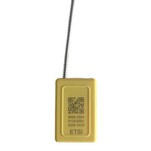
Our RFID seals for export containers tag combines a galvanized steel cable, battery-assisted UHF identification and three-state detection for international cargo routes. Its 341 × 50 × 19 mm IP66 housing is designed for locking applications on metal container hardware.
Export Container RFID Seal Specifications
The listed CAB1 or VBL7-NC configuration uses ISO 18000-6C Gen2V2 communication, separate identity and user-memory areas, and a battery activated through the locking workflow.
| Specification | Listed Configuration | Export Project Requirement |
|---|---|---|
| Tag dimensions | 341 × 50 × 19 mm | Check container-door and locking-bar clearance. |
| Antenna dimensions | 58 × 37 mm | Approve the installed orientation on metal. |
| Chip | CAB1 or VBL7-NC | Confirm state and sensor command support. |
| Protocol | ISO 18000-6C Gen2V2 | Use compatible readers and firmware. |
| TID or UID | 112 bits | Map the chip identity to the export record. |
| EPC or Block memory | 192 bits | Approve the EPC numbering structure. |
| User File_0 | 512 bits | Define the required compact project data. |
| Reserved memory | 112 bits | Confirm applicable access settings. |
| Operating frequency | 865–868 MHz | Verify use across every destination country. |
| Housing and cable | ABS housing and galvanized steel cable | Specify cable dimensions and locking route. |
| Reference read range | Up to 25 m, reader dependent | Validate each loading and terminal gate. |
| Installation | Locking style | Define issue, locking and removal authority. |
| Color | Yellow; customization available | Approve visibility and identification contrast. |
| Battery | Embedded 165 mAh battery | Plan storage and locking activation dates. |
| Listed endurance | Up to 12 months after locking | Include customs and terminal delays. |
| Protection | IP66 and suitable for on-metal use | Qualify actual route exposure. |
| Sensors | Temperature and detection sensors | Define the required data and alerts. |
| Electronic states | Unlocked, Locked and Tampered | Map each result to the release process. |
Prepare the Seal Before Export Dispatch
The seal identity, container number, booking and export documents should be reconciled before the container leaves the loading facility.
Issue the Seal
Capture the EPC, TID, visible number and production batch before assigning the seal.
Match Export Records
Associate the seal with the container, booking, shipment and destination information.
Lock the Container
Route the cable through approved hardware and complete the locking action.
Verify Before Release
Read the assigned identity and locked state before transport to the export terminal.
Use the Three States in Export Control
Available for Assignment
The seal is registered and associated with the export container before final closure.
Container in Secured Transit
The reader result should match the seal assigned at the loading or consolidation location.
Inspection Required
An unexplained changed condition should hold the container for documented investigation.
Export Container Chain of Custody
| Control Point | Record to Compare | Expected Result | Exception Action |
|---|---|---|---|
| Exporter loading site | Container, booking, cargo and assigned seal | Correct identity and Locked state | Do not release the container |
| Inland transport gate | Truck, container and planned route | Seal remains assigned and Locked | Route the unit to inspection |
| Export terminal entrance | Terminal booking and arriving container | Identity matches the pre-arrival record | Hold the gate transaction |
| Customs inspection | Inspection authorization and seal history | Opening is documented before removal | Record and investigate discrepancies |
| Transshipment terminal | Expected transfer and current seal data | Assigned seal remains Locked | Create a custody exception |
| Import receiving point | Original dispatch and arrival records | Receiver approves identity and state | Delay opening pending review |
Design Reader Coverage for Export Gates
Reader infrastructure should be tested with actual containers, vehicle speeds and adjacent metal structures rather than approved from the nominal distance alone.
Loading Facility
- Close-range issue and encoding station
- Locked-state verification point
- Container and seal reconciliation
- Controlled dispatch release
Port or Terminal Gate
- Lane width and vehicle speed
- Antenna height and polarization
- Adjacent-lane tag filtering
- Automatic exception routing
Inspection Area
- Controlled container orientation
- Identity and state commands
- Temperature-data retrieval
- Replacement-seal registration
Define International Frequency Requirements
| Route Information | Why It Is Required | Buyer Confirmation |
|---|---|---|
| Origin country | Determines the first reader environment | Applicable UHF band and reader settings |
| Transit countries | The seal may be read during inland transfer | Every planned checkpoint and frequency |
| Transshipment ports | Terminal systems may use different equipment | Reader model and integration requirement |
| Destination country | Arrival verification must meet local rules | Approved receiving-reader configuration |
| Future route expansion | Additional regions may require another version | Countries included in the purchasing plan |
Temperature and Battery Requirements
Define the sensor function and total export-route duration before relying on the tag for temperature-related cargo decisions.
Temperature Function
- Required measurement range
- Permitted accuracy or tolerance
- Spot, event or logging requirement
- Sampling and storage expectations
- Software alarm thresholds
Battery Planning
- Storage time before locking
- Battery activation record
- Planned sailing and inland duration
- Customs and terminal dwell time
- Possible route delays
Pre-Shipment Qualification
| Qualification Test | Method | Required Result | Project Record |
|---|---|---|---|
| Mechanical installation | Fit the cable to actual container hardware | No interference with locking bars or handles | Approved photographs and cable dimensions |
| State sequence | Test Unlocked, Locked and controlled opening events | Software shows the correct result | State and reader-command results |
| Gate reading | Move an applied seal through the intended lane | Identity and state meet the target read rate | Distance, speed and antenna settings |
| On-metal orientation | Test approved positions on the container door | Required reading performance is maintained | Orientation and read-rate data |
| Temperature function | Apply defined reference temperatures | Requested sensor behavior is confirmed | Test conditions and outputs |
| Data reconciliation | Compare EPC, TID, print and export records | All identifiers resolve to one seal | Encoding and matching file |
Customization for Export Programs
We can review the physical seal, visible data and electronic records after the export route and system integration are defined.
Physical Configuration
- Cable diameter and length
- Yellow or custom housing color
- Container locking-point fit
- Packaging and batch sequence
Visible Export Data
- Exporter or logistics logo
- Sequential seal number
- Barcode or QR code
- Operating and destination text
RFID Configuration
- EPC numbering structure
- TID and printed-code mapping
- User-memory allocation
- Encoding verification output
Information Needed for Configuration
Container Details
- Container and door type
- Locking-point photographs
- Cable dimensions and route
- Authorized opening method
Export Route
- Origin and destination countries
- Transit and transshipment locations
- Expected total route duration
- Temperature conditions
System and Order
- Reader and antenna models
- Required state and sensor data
- Artwork and encoding rules
- Quantity and delivery schedule
Related Export Container Seals
Compare frequency, read range, state functions, battery endurance, sensor requirements and container hardware before choosing another RFID seal.
Export Container RFID Seal Questions
Which states does the export container tag provide? +
The product description identifies Unlocked, Locked and Tampered states. Compatible reader commands and software are required to retrieve and interpret these results.
Is the seal reusable after it is locked? +
The seal is intended for one locking cycle. After authorized opening or cable removal, the event should be recorded and a newly registered seal assigned to the container.
Can the seal always be read from 25 meters? +
No. Up to 25 m is a reader-dependent reference. Container steel, tag orientation, antenna placement, vehicle speed, reader settings and local regulations affect the operating distance.
Can one frequency version cover every export country? +
The listed parameter is 865–868 MHz, while regional UHF rules and reader bands vary. Provide the complete route so compatibility can be reviewed before production.
Does the sensor provide continuous temperature logging? +
Continuous logging should not be assumed from the temperature-sensor listing alone. Specify the required range, accuracy, interval, data storage and alarm behavior for confirmation.
How long does the battery support the locked seal? +
The listed 165 mAh battery supports up to 12 months after locking. Storage, temperature, reading activity, sensor behavior and route duration can affect achieved endurance.
What information is required for a quotation? +
Please provide the container hardware, cable requirements, complete export route, reader models, required states, temperature function, artwork, encoding rules, quantity and delivery schedule.
Configure the Seal for Your Export Route
Send us the container hardware, cable size, origin and destination countries, reader setup, state workflow, temperature requirements, artwork and quantity for review.
Request an Export Container Seal ReviewHot Tags: rfid seals for export containers tag, China rfid seals for export containers tag manufacturers, suppliers, factory, rfid seal for dairy products, rfid seal for database management systems, rfid seal for laptops, rfid seal for voip phones, rfid seal for wind turbines, rfid sealing solution