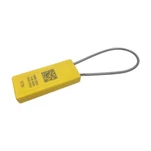
Our NFC seal tag combines an FM13HS01-P ISO 15693 chip, compact copper antenna and electronic tamper detection in an insert-mounted format. Its short reading distance supports deliberate, item-by-item inspection of instruments, cabinets, logistics closures and protected assets.
NFC Seal Tag Specifications
Confirm the complete seal construction, insertion point, reader compatibility and required detection result before approving this compact RFID component.
| Specification | Listed Configuration | Project Requirement |
|---|---|---|
| Tag dimensions | 19.5 × 20 × 0.45 mm | Confirm the available insertion cavity and clearance. |
| Antenna dimensions | 17.73 × 10.86 mm | Keep the copper antenna clear of damaging pressure. |
| Chip | FM13HS01-P | Verify reader commands and detection functions. |
| Protocol | ISO 15693 | Confirm ISO 15693 support on every reading device. |
| Memory | TID/UID, EPC/Block, User and Reserve | Define the required identifier and data structure. |
| User memory | 1024 bits | Confirm that the final record fits the available memory. |
| Operating frequency | 13.0–14.5 MHz | Test at the nominal HF operating conditions. |
| Surface protection | Protective ink overlay | Define moisture, abrasion and chemical exposure. |
| Reference read range | Up to 4.4 cm in free air | Test through the complete seal housing. |
| Installation | Insert mounting | Provide drawings of the receiving seal structure. |
| Security function | Tamper detection sensor | Define the trigger and retained electronic result. |
Choose NFC for Deliberate Close-Range Inspection
Unlike long-range UHF seals, this HF design requires the operator to bring a compatible reader close to the selected sealing point.
Controlled Tag Selection
The short range helps an operator select one seal without capturing equipment or inventory several meters away.
Compact Integration
The thin tag can be inserted into a compatible plastic seal or protected housing with limited internal space.
Local Data Access
A compatible reader can retrieve the approved identifier or user-memory data during inspection.
Tamper-State Check
The selected configuration can return a defined result related to the condition of the completed seal.
Reader-Controlled Workflow
The application determines what the operator sees for intact, changed, unknown or unreadable tags.
Low Cross-Read Risk
Close positioning can reduce unintended reads in dense instrument, cabinet and maintenance areas.
Confirm the Complete Seal Construction
| Construction Area | Information Required | Prototype Check | Approval Result |
|---|---|---|---|
| Tag cavity | Internal length, width and depth | Insert the 19.5 × 20 × 0.45 mm tag | No folding, crushing or movement |
| Antenna position | Orientation within the seal body | Read from the intended inspection face | Repeatable close-range response |
| Locking component | Wire, pin, strap or plug construction | Complete the normal locking operation | Secure mechanical engagement |
| Detection connection | Physical action linked to the sensor | Perform the approved opening simulation | Expected electronic state change |
| Protective housing | Plastic type, wall thickness and sealing method | Expose the assembly to expected handling | Tag remains protected and readable |
NFC Seal Tag Applications
Utility Meters
Integrate the tag into a compatible meter seal for close-range identity and service-condition checks.
Equipment Cabinets
Protect selected cabinet doors, service panels and access points that require individual inspection.
Valves and Instruments
Associate controlled valves or instruments with maintenance records and authorized opening procedures.
Logistics Closures
Use the tag inside a compatible seal for cases, boxes or cargo closures inspected at close range.
Warehouse Assets
Identify protected containers or high-value assets without creating a long-distance reading zone.
Service Components
Connect replaceable parts, filters or protected covers with service and replacement records.
Define the Seal Inspection Sequence
Register
Associate the tag identity and encoded data with the correct asset, seal or service point.
Insert
Install the tag in the approved seal structure and complete the defined locking operation.
Read
Place the compatible ISO 15693 reader near the designated reading face and verify the result.
Record
Store the inspection, opening or replacement result in the buyer's management system.
Plan the Reader and User Interaction
| Reading Method | Compatibility Requirement | Operator Action | Suitable Workflow |
|---|---|---|---|
| Industrial HF reader | ISO 15693 and required sensor commands | Present the seal at the approved distance | Maintenance and asset inspection |
| Handheld RFID terminal | Compatible HF module and application | Select the asset and scan its seal | Field service and warehouse checks |
| NFC-enabled phone | Confirmed ISO 15693 support | Position the phone antenna over the tag | Approved phone-based inspection |
| Desktop encoder | Chip and memory command support | Write and verify the approved data | Issuance and initialization |
Configure Identity, Memory and Detection Data
Tag Identity
- TID or UID capture
- Asset and seal association
- Duplicate-record controls
- Reader output format
User Data
- Data within 1024-bit memory
- Asset or service identifier
- Access and write permissions
- Finished encoding verification
Detection Result
- Initial sealed condition
- Defined opening trigger
- Retained post-event state
- Software exception response
Information Needed for Configuration
Physical Integration
- Complete seal drawings or photographs
- Available insertion-cavity dimensions
- Locking component and opening method
- Metal distance and housing material
- Moisture and handling conditions
Reader and Data
- Reader or phone model
- Required inspection distance
- Detection-state workflow
- Memory and encoding requirements
- Quantity and delivery destination
Related NFC and RFID Security Seals
Compare protocol, reading distance, finished seal structure and detection behavior before selecting another RFID seal.
NFC Seal Tag Questions
Is this a complete ready-to-use wire seal? +
The listed 19.5 × 20 × 0.45 mm size describes a compact insert-mounted tag. The complete plastic housing, wire, plug or locking structure must be confirmed for the intended seal.
Can every NFC smartphone read the FM13HS01-P chip? +
No. The phone must support ISO 15693, and software support may also be required for memory or detection commands. Test every intended phone model before deployment.
Is the 4.4 cm reading distance guaranteed? +
No. Up to 4.4 cm is a free-air reference. Reader antenna size, tag orientation, protective housing, nearby metal and the installation structure affect the actual distance.
Can this NFC seal be read in bulk from a distance? +
The product is intended for close-range HF inspection. If long-distance portal reading or large-area bulk inventory is required, a suitable UHF seal should be evaluated instead.
How does the tamper-detection sensor work? +
The exact result depends on how the tag is electrically and mechanically integrated into the finished seal. Define the opening trigger and verify the state before and after controlled removal.
Does the tag automatically send a tamper alert? +
No autonomous wireless alert function is listed. A compatible reader must interrogate the tag, and the connected application must interpret and display the detection result.
Can the NFC seal tag be installed directly on metal? +
Direct metal placement can detune a standard HF antenna. Provide the complete seal structure and distance from metal so the mounting arrangement can be tested.
What information is required for a quotation? +
Please provide the complete seal structure, insertion-cavity dimensions, locking and opening method, reader or phone models, detection requirement, encoding data, quantity and destination.
Integrate the NFC Tag into Your Seal Structure
Send us the seal drawing, insertion space, locking method, opening trigger, reader models, memory requirements, encoding rules and quantity for configuration review and pricing.
Request an NFC Seal Configuration ReviewHot Tags: nfc seal tag, China nfc seal tag manufacturers, suppliers, factory, rfid seal for content management software, rfid seal for document, rfid seal for drawers, rfid seal for filters, rfid seal for perishable goods, rfid seal for wind turbines