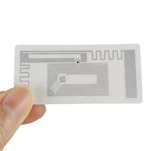
Removal-Sensitive UHF Identification
An RFID Identity That Cannot Be Transferred Intact
Our RFID Anti Theft Label is a slim UHF adhesive tag for packaging, books, archives and selected non-metal assets. Its R6-P chip supports ISO 18000-6C Gen2, while the removal-sensitive antenna structure is intended to break when the label is peeled from its original surface.
The 90 × 7 × 0.2 mm format suits applications where the tag must occupy limited surface space. Its listed 920.5–924.5 MHz frequency and up-to-50 cm free-air reading range must be checked against the destination market, reader, antenna, mounting surface and required workflow.
RFID ANTI THEFT LABEL
R6-P Chip ISO 18000-6C 90 × 7 mm Format Tamper Proof
Model-Specific Data
RFID Anti Theft Label Specifications
Confirm the frequency, mounting substrate and installed reading distance before bulk production. The published reading range is a reference under free-air conditions and is not a fixed result for every tagged item.
| Product | RFID Anti Theft Label |
|---|---|
| Tag dimensions | 90 × 7 × 0.2 mm |
| Antenna size | 85 × 7 mm |
| Chip | R6-P |
| Protocol | ISO 18000-6C Gen2 |
| Operating frequency | 920.5–924.5 MHz |
| Memory | TID/UID: 96 bits; EPC: up to 128 bits; user memory: up to 32 bits |
| Reserved memory | 32-bit access password and 32-bit kill password |
| Face material | Dual silicon and transparent PET liner |
| Published read range | Up to 50 cm on a free-air surface, reader dependent |
| Installation | Adhesive attachment |
| Security characteristic | Tamper-proof removal response |
Surface limitation: Tell us if the target item contains exposed metal, liquid or another RF-sensitive material so the installation can be reviewed before sampling.
Security Logic
01
02
03
04
05
06
What the Tamper-Proof Structure Controls
Unauthorized Transfer
Peeling is intended to damage the antenna path, so an intact electronic identity cannot simply be moved to another package, book or asset.
Tag Substitution
A single-use removal response helps expose attempts to detach the original identifier and reuse it on a different item.
Inventory Identity
The R6-P chip and EPC memory support electronic identification within a compatible UHF inventory or asset-management system.
Visible Identification
Barcodes, text and other printing options can connect the RFID identity with a visible code used by receiving or inspection teams.
Password Planning
Access and kill password fields are available, but the buyer must define how passwords will be created, stored and used by the system.
Batch Verification
Our encoding equipment can read RFID data, test performance, scan printed codes and reject defective tags during production.
Application Fit
Suitable Identification Workflows
- Retail goods: tag selected packaging, cosmetics, electronics or other controlled merchandise.
- Books and archives: identify items for circulation, inventory checks and configured security workflows.
- Warehouse inventory: register and count tagged goods with compatible UHF readers.
- Office assets: assign electronic identities to selected computers, printers and other equipment.
- Brand protection: combine a unique RFID identity with printed serialization or visible codes.
Application Limits
When a Sample Test Is Essential
RF performance changes with the tagged item and its surroundings. Testing is especially important when the label will be placed close to metal, liquid-filled products, curved packaging, dense stacks or multiple adjacent tags.
- Test on the exact product and packaging material.
- Use the intended reader and antenna arrangement.
- Check both single-tag and batch-reading conditions.
- Evaluate attachment after normal surface preparation.
- Test removal behavior on a separate sample.
RF and System Matching
Information Needed Before Approval
- Destination country and permitted UHF frequency
- Reader model, antenna and configured RF power
- Tagged product, packaging and mounting surface
- Required reading distance and scanning direction
- Expected number of tags inside the reading zone
- EPC structure, user-memory data and passwords
- Quantity, artwork, encoding and packaging needs
Customization
Printing and Data Preparation
We support ODM, OEM and SKD requirements for this product. Listed finishing and identification options include monochrome or color printing, barcodes, text, embossing, laser engraving, personalization and RFID encoding.
For variable-data orders, send the required EPC format and a sample data file. Printed text, barcode values and electronic records should follow an approved mapping rule so the delivered batch can be reconciled with the buyer's database.
Review Our RFID Customization CapabilitiesOrder Workflow
From Tagged Item Review to Batch Encoding
- Define the target item We review the product, packaging, installation surface and security objective.
- Match the RF configuration We check the operating frequency, reader, antenna and required identification distance.
- Prepare the identification rules Printing artwork, EPC structure, passwords and variable-data relationships are confirmed.
- Test representative samples The buyer verifies attachment, reading behavior and removal response on the actual item.
- Approve production references Printing, encoding, data mapping and packaging references are agreed before batch production.
- Verify RFID data Our encoding and inspection system supports chip reading, RF testing, code scanning and defective-tag rejection.
Manufacturing Support
RFID Production and Verification Resources
We have focused on security RFID tags for more than 16 years. Our site lists flip-chip equipment, an anechoic chamber and encoding equipment among our production and inspection resources.
Our customization work covers antenna design, IC selection, material engineering, printing, encoding, prototype validation and mass production. For this label, approval should remain tied to the R6-P configuration and the buyer's actual surface and reader conditions.
Related Selection Routes
Continue Product and Application Review
Procurement Questions
RFID Anti Theft Label FAQ
What happens when the RFID Anti Theft Label is removed? +
The tamper-proof construction is intended to damage the antenna when the label is peeled from its original surface. This makes the tag unreadable and helps prevent intact transfer to another item. Confirm the removal response on the actual substrate during sample testing.
Will this label work with our existing UHF reader? +
The reader must support ISO 18000-6C Gen2 and the listed 920.5–924.5 MHz configuration. Send us the reader model, antenna and deployment country so the system match can be reviewed.
Is the listed 50 cm reading range guaranteed? +
No. The published value is up to 50 cm on a free-air surface and depends on the reader. The tagged material, antenna position, RF power, tag orientation and nearby objects affect the installed result.
Can the label be used directly on metal assets? +
This model is not identified as an anti-metal tag in its published specifications. Metal can detune a conventional UHF antenna, so send the asset material and mounting position for review before selecting the tag.
Can you encode EPC values and print matching codes? +
Yes. We support RFID encoding, personalization, barcode and text printing. Provide the EPC structure, visible-code format and sample data so the printed and electronic identities can follow an approved mapping rule.
What should we provide for sample preparation? +
Provide the destination country, tagged-item sample or material description, reader details, required read distance, quantity, artwork and encoding requirements. Standard printing and basic encoding samples are listed with a typical 2–3 day preparation time after requirements are confirmed.
Test the Label on Your Actual Product Surface
Send us the tagged item, mounting material, reader model, deployment country, required scanning distance, order quantity and encoding requirements. We will review the application before defining the sample and quotation scope.
Hot Tags: rfid anti theft label, China rfid anti theft label manufacturers, suppliers, factory, anti tamper rfid use, anti tampering rfid installation, anti tampering rfid technology, rfid protection market, secure rfid tag, tamper resistant rfid setup