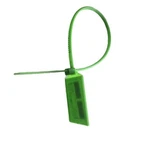
Our plastic seal security tags combine a hanging ABS wire-seal housing, UHF identification and electronic tamper detection for containers, trucks, bonded cargo and controlled logistics assets. The 133 × 38 × 16 mm format supports long-range gate reading without requiring a battery.
Plastic Seal Security Tag Specifications
The listed configuration uses a CAB1 or VBL7-NC chip with ISO 18000-6C Gen2V2 communication, an ABS housing and an aluminum antenna designed for long-range UHF identification.
| Specification | Listed Configuration | Project Selection |
|---|---|---|
| Tag dimensions | 133 × 38 × 16 mm | Check door hardware, clearance and hanging position. |
| Antenna dimensions | 93 × 26 mm aluminum antenna | Preserve the specified antenna area and orientation. |
| Net weight | 50 g without wire | Add the selected wire when calculating installed weight. |
| Chip | CAB1 or VBL7-NC | Confirm chip selection with the reader and software. |
| Protocol | ISO 18000-6C Gen2V2 | Use compatible UHF readers and commands. |
| TID or UID | 112 bits | Define identifier capture and database mapping. |
| EPC or Block memory | 192 bits | Approve the EPC format before encoding. |
| User File_0 | 512 bits | Allocate only data required by the application. |
| Reserved memory | 112 bits | Confirm access-control requirements during integration. |
| Operating frequency | 860–960 MHz | Select the regional configuration for deployment. |
| Housing | ABS plastic | Validate exposure, impact and handling conditions. |
| Reference read range | Up to 11 m in open-air conditions | Verify the distance with the final reader installation. |
| Installation | Hanging style with locking wire | Specify wire diameter, length and locking route. |
| Primary function | Electronic tamper detection | Map each seal condition to the operating system. |
How the RFID Wire Seal Enters Service
A controlled deployment connects the physical seal number, RFID identity, cargo record and final locking event before the vehicle or container leaves the loading point.
Assign
Read the tag identity and associate it with the container, truck, shipment or protected asset.
Route
Pass the selected wire through the approved locking points without obstructing the UHF antenna.
Lock
Complete the mechanical seal operation and record the resulting electronic condition.
Verify
Confirm the EPC, seal condition and shipment relationship before dispatch.
Use Each Electronic Condition in the Workflow
The software should retain the tag identity and expected seal condition so operators can distinguish a normal operational event from an exception.
Tag Assignment
Register the RFID identity, printed number, vehicle or container ID and shipment reference before closure.
Dispatch Verification
Confirm that the assigned tag is readable and that the expected secured condition is returned.
Exception Handling
Compare the detected condition with the authorized opening record before releasing the shipment.
Applications for Plastic RFID Security Seals
The hanging structure supports security points that can accept a locking wire while leaving enough clearance for the RFID housing.
Container Door Control
Attach the seal through approved locking hardware and record its relationship with the container and cargo manifest.
Truck and Trailer Dispatch
Use the RFID identity and seal condition at loading bays, fleet gates and controlled receiving points.
Bonded Cargo Supervision
Associate each serialized seal with the supervised shipment and its authorized inspection events.
Warehouse Gate Reading
Capture seal identities without requiring operators to visually scan every printed code.
Equipment Access Control
Protect cabinets, valves or movable equipment where the locking points accept the selected wire.
Reusable Route Records
Maintain shipment history in the connected database while assigning a new seal identity to each secured trip.
Plan the UHF Reading Zone
Reader power alone does not determine a reliable gate result. Antenna position, polarization, vehicle movement, nearby metal and the direction of the seal must be tested together.
| Reading Area | Installation Requirement | Acceptance Result |
|---|---|---|
| Loading station | Provide a close confirmation point for assignment and locking. | Correct seal and shipment records are paired. |
| Vehicle gate | Define lane width, vehicle speed and reader antenna coverage. | The intended seal is captured throughout the approved lane. |
| Container yard | Test reflections and shadowing around stacked metal containers. | Required reading positions meet the project target. |
| Inspection point | Provide a controlled orientation for status verification. | Identity and electronic condition are both available. |
| Receiving gate | Connect reader events with expected arrival records. | Unexpected identities or conditions enter an exception queue. |
Define RFID and Printed Data Together
The electronic identity should correspond with the visible seal information and the buyer's shipment database.
Electronic Records
- EPC serialization format
- TID or UID capture
- User-memory allocation
- Access-control configuration
- Tamper-condition interpretation
Visible Identification
- Sequential seal number
- Barcode or QR code
- Logo and operating text
- Color and contrast requirements
- Laser or printed information
Database Mapping
- Container or vehicle ID
- Shipment and route reference
- Authorized locking event
- Inspection and opening record
- Exception-resolution status
Qualification Tests Before Volume Deployment
| Test | Method | Approval Criterion | Project Record |
|---|---|---|---|
| Hardware fit | Install the selected wire on actual doors or equipment. | Housing and wire clear all moving parts. | Approved installation photographs |
| Locked reading | Read the tag at each planned gate and inspection point. | Identity and required condition are captured. | Reader settings and antenna positions |
| Tamper response | Open or cut controlled samples using the expected method. | The changed condition is recognized by the system. | Sample number and reader result |
| Metal environment | Repeat reads beside vehicles and stacked containers. | Coverage meets the defined operational zone. | Read-rate and missed-read results |
| Data matching | Compare EPC, printed code and shipment records. | All identifiers resolve to the same assigned seal. | Encoding and reconciliation file |
| Handling trial | Expose samples to planned transport and storage handling. | Housing, printing and RFID response remain acceptable. | Trial conditions and inspection results |
Customization for Logistics Projects
We can review the physical configuration, visible identification and encoded records against the buyer's operating process.
Physical Configuration
- Wire diameter and required length
- Housing color and visible contrast
- Installation route and locking point
- Regional UHF frequency configuration
- Packaging and sequential issue order
Printing and Encoding
- Logo, text and operating instructions
- Barcode, QR code or serial number
- EPC data and numbering structure
- Printed-to-RFID data matching
- Required encoding output file
Information Required for Configuration
Seal Installation
- Container, truck or equipment type
- Photographs of the locking point
- Required wire size and route
- Expected opening procedure
RFID System
- Deployment country or frequency
- Reader and antenna models
- Gate width and reading distance
- Required electronic conditions
Order Data
- EPC and printed numbering rules
- Artwork and barcode format
- Quantity and delivery batches
- Destination country
Related RFID Security Seal Options
Compare seal dimensions, wire construction, read range, electronic condition support and installation hardware before selecting a model.
Plastic Seal Security Tag Questions
What is the maximum listed reading distance? +
The listed reference is up to 11 m in open-air conditions. The achieved distance depends on reader power, antennas, polarization, seal orientation, nearby metal and local radio regulations.
Does the RFID tag detect physical opening? +
The listed CAB1 or VBL7-NC configuration supports electronic tamper detection. The reader software must interpret the chip condition and compare it with the expected operational record.
Can one configuration be used in different countries? +
The product covers the 860–960 MHz UHF range, but regional frequency rules and reader settings differ. Provide every destination country so the required frequency configuration can be reviewed.
Why can the reading distance decrease near containers? +
Metal doors and stacked containers can reflect or block UHF signals. Applied testing should establish the tag orientation, reader antenna angle and lane coverage required by the site.
What can be stored in the user-memory area? +
The listed chip provides 512 bits of User File_0 memory. A project may allocate this space to compact application data, although frequently changing route and inspection records are usually easier to manage in the connected database.
Can the wire length and printed data be customized? +
Wire requirements, housing presentation, text, logo, barcode, QR code, serial numbering and RFID encoding can be reviewed against the application and order specification.
What information is needed for a quotation? +
Please provide the locking-point photographs, wire requirements, deployment region, reader setup, encoding format, artwork, quantity, delivery batches and destination country.
Configure the Seal for Your Logistics System
Send us the locking-point details, wire requirements, frequency region, reader setup, data format, artwork and quantity for configuration review and pricing.
Request a Plastic Seal Tag ReviewHot Tags: plastic seal security tags, China plastic seal security tags manufacturers, suppliers, factory, rfid seal for alcohol, rfid seal for bricks, rfid seal for filters, rfid seal for furniture, rfid seal for oil and gas, rfid seal for truck