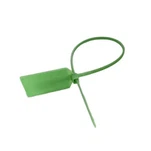
Our RFID cable tie tag combines UHF identification, an IP66 PC housing and hanging-style installation for cables, pipes, trays, valves and industrial equipment. CAB1 and VBL7-NC configurations support different identification and sensing requirements.
RFID Cable Tie Tag Specifications
Select the chip, memory structure and sensing functions according to the inspection workflow, installation surface and reader environment.
| Specification | Available Configuration | Project Requirement |
|---|---|---|
| Overall dimensions | 270 × 33.5 × 5.8 mm | Confirm the bundle diameter and available clearance. |
| Chip | CAB1 or VBL7-NC | Match the chip to the required memory and sensing functions. |
| Protocol | ISO 18000-6C Gen2 V2 | Confirm compatibility with the intended UHF reader. |
| Frequency | 860–960 MHz | Specify the operating country and reader band. |
| TID or UID memory | 112 bits | Define how the identifier maps to the asset record. |
| EPC or block memory | 192 bits | Provide the required EPC format and numbering rules. |
| User memory | 512 bits | Confirm the data fields before encoding. |
| Reserved memory | 112 bits | Define access and kill-password requirements. |
| Reference read range | Up to 5 m, reader dependent | Test the applied tag with the final reader setup. |
| Housing | PC | Confirm chemical, impact and temperature exposure. |
| Ingress protection | IP66 | Match the enclosure rating to the field conditions. |
| Installation | Hanging or cable-tie style | Provide the item diameter and installation photographs. |
| Application surface | Suitable for on-metal projects | Test the orientation and spacing on the actual asset. |
| Color | Green, red, white or customized | State any visual classification requirements. |
| Sensor options | Temperature and detection sensing | Confirm the selected model and required sensor behavior. |
Identify Cables, Pipes and Field Equipment
The cable-tie format attaches an electronic identity to assets that may not provide a practical flat label area.
Cable Bundles
Assign an RFID identity to power, communication or control-cable groups for field inspection and maintenance records.
Pipes and Hoses
Attach the tag around a suitable pipe, hose or support point without relying on a large adhesive surface.
Valves and Fittings
Connect valves and service fittings with asset IDs, inspection schedules and maintenance information.
Cable Trays
Mark tray sections, routing zones and connection points for faster location checks during maintenance rounds.
Industrial Equipment
Identify machinery, tools and large equipment where a hanging tag is more suitable than a surface label.
Logistics Assets
Apply the tag to compatible pallets, logistics boxes and transport assets for UHF inventory processes.
Plan the Attachment Position
| Installation Area | Positioning Requirement | Applied Test |
|---|---|---|
| Cable bundle | Keep the RFID housing visible and clear of crushing points. | Check fastening stability and handheld reading from each approach. |
| Metal pipe | Use the approved orientation for the on-metal configuration. | Measure the reading zone on the actual pipe diameter. |
| Valve assembly | Avoid moving parts, hot surfaces and service obstructions. | Operate the valve and inspect the tag clearance. |
| Cable tray | Choose a repeatable position that technicians can reach safely. | Read neighboring tags and check for unintended selection. |
| Machine frame | Protect the tag from impact, vibration and pinch points. | Inspect retention after the expected operating cycle. |
| Logistics asset | Keep the tag clear of stacking and handling contact areas. | Test the planned reader distance while the asset is loaded. |
Build a Repeatable Field Inspection Workflow
A consistent relationship between the physical tag, encoded identity and asset database helps technicians obtain the correct record.
Assign
Create the approved relationship between the EPC, tag identity and equipment record.
Install
Fasten the tag at the documented position without damaging the housing or obstructing the asset.
Read
Use the approved handheld or fixed reader to retrieve the tag data during inspection.
Update
Record the inspection result, maintenance action or location change in the connected system.
Define Identification and Sensor Data
The RFID identity, optional sensing function and application software perform different parts of the asset-management process.
| Data Element | Typical Use | System Definition |
|---|---|---|
| EPC | Operational asset or item number | Define the numbering format and duplicate controls. |
| TID or UID | Chip-level tag reference | Decide whether it must be captured with the EPC. |
| User memory | Selected project data fields | Specify data length, access rules and update authority. |
| Temperature value | Reading from a compatible sensor configuration | Confirm measurement range, accuracy and reading method. |
| Detection status | Configured state from the selected detection sensor | Define the trigger condition and software response. |
| Inspection record | Time, operator, location and maintenance result | Store and manage the record in the buyer's application. |
Match the Tag to the Reader Deployment
Handheld Inspection
Technicians can read selected cables, pipes or equipment during scheduled field rounds. Confirm the working distance and selection accuracy.
Maintenance Point
A controlled reader position can identify tagged equipment at a service location when the asset orientation remains repeatable.
Warehouse or Logistics Zone
Fixed UHF readers may support compatible logistics assets after antenna placement and surrounding-tag selection are validated.
Printing, Encoding and Visual Identification
We can review the visible marking and electronic data together so the installed tag corresponds with the correct asset record.
Visible Marking
- Barcode or QR-code printing
- Laser-engraved identification
- Text and asset numbers
- Custom visual classifications
RFID Encoding
- Customer-defined EPC format
- Personalized RFID encoding
- Password configuration if required
- Electronic-data verification
Order Reconciliation
- EPC and printed-code matching
- Variable-data input review
- Duplicate-number checking
- Finished-data output requirements
Information Needed for Configuration
Asset and Installation Details
- Asset type and attachment photographs
- Cable, pipe or bundle diameter
- Metal surface and available clearance
- Temperature, water and chemical exposure
- Impact, vibration and movement conditions
RFID and Data Requirements
- Operating country and UHF band
- Reader model and required reading distance
- Chip and sensor requirements
- EPC, printing and encoding rules
- Color, quantity and destination country
Related RFID Security and Cable Seals
Compare attachment length, locking structure, sensing functions, environmental protection and reader performance before selecting a model.
RFID Cable Tie Tag Questions
Is 270 mm the usable cable-tie length? +
The listed 270 × 33.5 × 5.8 mm measurement describes the overall product size. Provide the cable, pipe or bundle diameter so the usable fastening range can be confirmed.
Can the tag be installed on a metal pipe? +
The product is listed for on-metal use. Reading performance still depends on pipe diameter, tag orientation, surrounding structures and reader setup, so applied testing is required.
Is the 5 m reading distance guaranteed? +
No. Up to 5 m is a reference result. The reader, antenna, output power, tag orientation, metal structure, interference and installation environment affect the actual range.
Does the temperature sensor store a complete history? +
Historical logging should not be assumed from the general product description. Confirm the selected chip, measurement range, accuracy, sampling behavior, memory and reader method.
Can the detection sensor report a cut cable tie? +
The reported event depends on the selected sensor construction and trigger design. Define the required cut, opening or state-change condition and verify it with applied samples.
Can this tag measure electrical current in a cable? +
The listed tag provides UHF identification with optional temperature and detection sensing. It should not be described as measuring cable voltage or electrical current unless a confirmed configuration provides that function.
Can the RFID cable tie tag be reused? +
Reusability depends on the final locking and attachment structure. State whether the application requires a permanent seal, a removable tie or repeated installation before configuration.
What information is required for a quotation? +
Please provide the asset type, attachment photographs, bundle diameter, metal environment, sensor requirement, operating country, reader model, encoding data, color, quantity and destination.
Configure an RFID Cable Tie Tag for Your Assets
Send us the asset type, attachment position, bundle diameter, operating environment, sensor requirements, reader model, encoding rules and quantity for configuration review and pricing.
Request an RFID Cable Tie Tag ReviewHot Tags: rfid cable tie tag, China rfid cable tie tag manufacturers, suppliers, factory, rfid seal for application software, rfid seal for financial management systems, rfid seal for fpgas, rfid seal for hazardous materials, rfid seal for jewelry, rfid seal for vehicle