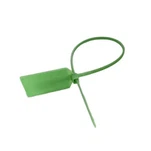
Our RFID security seals tag combines a 3.5 mm galvanized steel wire, ABS housing and ETSI-band UHF identification. It is intended for European-region projects that need each physical seal, printed serial number and electronic identity supplied as a controlled production record.
RFID Security Seals Tag Specifications
Confirm the security-seal construction, ETSI reader compatibility and identifier format before approving the purchase specification.
| Procurement Item | Listed Configuration | Required Purchase Input |
|---|---|---|
| Wire diameter | 3.5 mm galvanized steel wire | Locking-hole and cable-route dimensions |
| Seal dimensions | 300 × 59 × 20 mm | Available installation clearance |
| Chip | KX2005X-BL | Reader and software compatibility |
| Protocol | ISO 18000-6C Gen2 | Approved RFID system |
| TID or UID | 96 bits; customizable to 192 bits | Required identity length |
| EPC memory | 96 bits; extendable to 240 bits | Serial encoding structure |
| User memory | 1312 bits | Approved data requirement |
| Reserved memory | 64 bits | Access-control instruction |
| Operating frequency | 865–868 MHz ETSI | Countries of operation |
| Reference read range | Up to 5 m in free air or near metal | Approved test configuration |
| Construction | ABS housing and galvanized steel cable | Operating environment |
| Installation | Hanging style | Sealing and removal procedure |
Create a Complete Seal Purchase Specification
Mechanical Specification
- 3.5 mm wire requirement
- Seal body dimensions
- Locking-point compatibility
- Authorized removal method
RFID Specification
- KX2005X-BL chip
- 865–868 MHz ETSI band
- TID and EPC lengths
- User-memory requirement
Identification Specification
- Human-readable serial number
- Barcode or QR code
- Printed-to-RFID mapping
- Customer artwork
Testing Specification
- Approved reader and antenna
- Test distance and orientation
- Mechanical sample method
- Acceptance criteria
Packaging Specification
- Quantity per packaging unit
- Serial range identification
- Batch label information
- Customer shipping marks
Data Specification
- Source-file format
- Electronic output fields
- Number-range ownership
- Duplicate-data rules
Control Each Serialized Production Batch
Reserve Numbers
Approve the printed and electronic identifier range assigned to the production order.
Encode and Print
Apply the approved EPC, optional user data and matching visible identification.
Verify Records
Check RFID response and reconcile printed numbers with the electronic production file.
Pack by Range
Separate finished seals into identified batches that can be received and issued accurately.
Match Physical and Electronic Identifiers
| Identifier | Purpose | Expected Relationship | Buyer Use |
|---|---|---|---|
| Visible seal number | Manual inspection reference | Matches one production record | Documents sealing and removal |
| Barcode or QR code | Optical data capture | Matches the approved visible number | Supports non-RFID workflows |
| EPC | Routine UHF identification | Maps to the issued seal record | Reader-based inventory and verification |
| TID or UID | Chip identity | Retained with the assigned EPC | Additional electronic comparison |
| Batch number | Production traceability | Covers a defined group of seals | Receiving and exception control |
Validate the ETSI UHF Configuration
Reader Compatibility
- ISO 18000-6C Gen2 support
- 865–868 MHz operation
- Required memory commands
- Middleware data output
Applied Position
- Final cable route
- Housing orientation
- Nearby container metal
- Reader-to-seal distance
Site Conditions
- Reader antenna placement
- Adjacent tagged cargo
- Expected movement speed
- Local radio configuration
Plan Incoming Inspection
| Inspection Area | Sample Check | Required Record | Failure Response |
|---|---|---|---|
| Seal body and wire | Dimensions, appearance and assembly | Batch and sample identity | Hold the affected batch |
| Visible numbering | Sequence and readability | Approved number range | Identify the affected sequence |
| EPC encoding | Length, value and uniqueness | Production output file | Quarantine incorrect records |
| TID relationship | Mapping with the corresponding EPC | EPC-to-TID file | Reconcile the data batch |
| RFID performance | Read with the approved setup | Reader, power and distance | Retest and investigate variation |
Security Seal Applications
European Container Routes
Use the ETSI-band configuration at compatible reader locations along approved transport routes.
Trailer Door Security
Apply the 3.5 mm wire to compatible locking hardware after checking the cable route.
High-Value Cargo
Combine serialized RFID records with controlled physical inspection and opening procedures.
Warehouse Transfers
Identify secured cargo units moving between reader-equipped storage and dispatch areas.
Air Cargo Equipment
Evaluate the hanging body and wire dimensions against the specific cargo-unit fitting.
Controlled Asset Storage
Use serialized seals on compatible cabinets, cages or protected industrial access points.
Information Needed for Configuration
Seal Requirements
- Application and locking hardware
- Locking-hole dimensions
- Required wire route
- Operating and storage conditions
- Removal and disposal procedure
RFID and Order Requirements
- Countries where seals will be read
- Reader and antenna models
- TID, EPC and user-memory requirements
- Artwork and serial-number format
- Packaging, quantity and destination
Related RFID Security Seal Models
Compare regional frequency, memory, wire construction, reading distance and installation style across related seals.
RFID Security Seals Tag Questions
Is this RFID security seal configured for the ETSI band? +
Yes. The listed configuration operates at 865–868 MHz. Confirm every country where the tag will be read and configure the reader according to applicable regional requirements.
What locking hardware can accept the 3.5 mm wire? +
The opening and complete cable path must accommodate the 3.5 mm wire without excessive bending or obstruction. Provide measured dimensions and photographs for fit review.
Can the EPC be extended beyond 96 bits? +
The listed KX2005X-BL configuration supports EPC extension up to 240 bits. Confirm the required EPC length, encoding structure and reader software compatibility before production.
How are printed numbers matched with RFID data? +
We can coordinate the printed serial number, barcode or QR code with the EPC and required TID record, then provide the approved mapping fields in an electronic file.
Is the five-meter reading distance guaranteed? +
No. Five meters is a reference maximum. Reader power, antenna placement, seal orientation, nearby metal, interference and regional settings affect the final result.
Does an EPC change prove that the seal was tampered with? +
An unexpected RFID result should trigger inspection, but its cause must be verified from the wire, housing, reader output and custody records. RFID data alone should not replace physical examination.
What information is required for a quotation? +
Please provide the application, locking-hole dimensions, operating countries, reader models, required distance, TID and EPC lengths, user-data requirement, artwork, numbering, packaging, quantity and destination.
Define the Security Seal Purchase Specification
Send us your locking hardware, ETSI reader setup, identifier structure, printed numbering, inspection method, packaging and quantity for configuration review and pricing.
Request a Security Seal Specification ReviewHot Tags: rfid security seals tag, China rfid security seals tag manufacturers, suppliers, factory, rfid seal for environmental management systems, rfid seal for microprocessors, rfid seal for packing machines, rfid seal for switches, rfid seal for tiles, rfid sealing solution