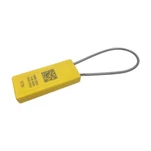
Our RFID cable seal security tag combines long-range UHF identification, an IP66 PC housing and optional sensing in a 270 mm hanging-style format. It is intended for cables, pipes, equipment, vehicle compartments and other metal-area sealing points that require remote identity verification.
RFID Cable Seal Security Tag Specifications
Select the chip and sensor configuration according to the sealing point, regional frequency, required reading zone and expected removal result.
| Specification | Available Configuration | Order Requirement |
|---|---|---|
| Overall dimensions | 270 × 33.5 × 5.8 mm | Confirm the usable loop and locking-point dimensions. |
| Chip | CAB1 or VBL7-NC | Select according to the required sensor behavior. |
| Protocol | ISO 18000-6C Gen2 V2 | Confirm compatibility with the planned UHF readers. |
| Frequency | 860–960 MHz | Specify the operating country and reader band. |
| TID or UID | 112 bits | Define how it maps to the seal or asset record. |
| EPC or block memory | 192 bits | Provide the required EPC numbering rules. |
| User memory | 512 bits | Confirm the required data fields and permissions. |
| Reserved memory | 112 bits | Define password-management requirements. |
| Housing | PC | Confirm impact, chemicals and temperature exposure. |
| Reference read range | Up to 16 m, reader dependent | Validate the applied seal in its final reading zone. |
| Installation | Hanging style | Provide photographs of the intended sealing point. |
| Colors | Green, red, white or customized | Define visible status or department colors. |
| Environmental design | IP66 and on-metal use | Test the final orientation and field conditions. |
| Sensor options | Temperature and detection sensors | Specify the measurement or trigger requirement. |
Apply the Seal to Controlled Access Points
The longer hanging structure is suited to assets that require a flexible loop around or through the protected opening.
Equipment Cabinets
Bridge compatible cabinet doors and frames so the RFID identity remains associated with the protected access point.
Vehicle Compartments
Apply the seal to a suitable truck or service-compartment closure after checking movement and metal clearances.
Cable Installations
Identify and control selected cable bundles, junction areas or service loops during inspection and maintenance.
Pipes and Valves
Attach the seal to compatible pipes, valves or fittings without obstructing operation or required servicing.
Industrial Assets
Link machinery, large tools or field equipment to inspection, maintenance and authorization records.
Logistics Equipment
Use the electronic identity at suitable cargo, pallet-box or transport-equipment sealing positions.
Approve the Physical Sealing Position
| Sealing Position | Installation Check | Operational Check | RFID Check |
|---|---|---|---|
| Cabinet door | Measure aligned holes and closing clearance | Open and close the door before final sealing | Read from normal inspection approaches |
| Vehicle compartment | Avoid hinges, latches and crushing areas | Check vibration and road movement | Test beside the actual vehicle body |
| Cable bundle | Confirm the loop size and fastening pressure | Avoid restricting cable movement or ventilation | Measure range in the installed orientation |
| Pipe or valve | Keep clear of hot and moving components | Confirm access for normal servicing | Test against the actual metal geometry |
| Equipment frame | Select a protected attachment point | Inspect exposure to impact and vibration | Check for unwanted nearby-tag reads |
Verify the Seal Through Its Service Cycle
Register
Associate the EPC and TID with the equipment, access point or shipment before installation.
Apply
Install the seal at the approved location and capture its initial electronic condition.
Inspect
Read the seal during scheduled checks and compare the result with the expected asset record.
Remove
Follow the authorized removal procedure and record the physical and electronic result.
Define Each Inspection Result
The buyer's software should distinguish identity, physical condition, sensor state and inspection history instead of treating them as one result.
| Inspection Result | Operator Check | System Action |
|---|---|---|
| Expected identity | EPC and asset record correspond | Display the approved equipment or seal record |
| Unknown identity | No approved record matches the tag | Withhold authorization and request investigation |
| Physical damage | Housing, cable or locking point is altered | Record photographs and inspection findings |
| Changed sensor state | Electronic result differs from the initial state | Apply the project's exception procedure |
| Unreadable seal | No reliable tag response is obtained | Rescan under controlled conditions and inspect physically |
| Authorized removal | Removal matches an approved work order | Close the record and issue a replacement if required |
Plan the Long-Range Reading Zone
The listed maximum distance is useful only when the reader, antenna and surrounding metal create a controlled capture zone.
Handheld Maintenance Round
Reduce reader power when technicians must select one seal among several nearby equipment tags.
Controlled Facility Gate
Test antenna height, lane width, equipment orientation and movement speed before fixed-reader deployment.
Warehouse Inspection Zone
Use a documented position to verify sealed assets while controlling unintended reads from surrounding inventory.
Configure Identification and Sensor Data
| Data Element | Available Function | Project Definition |
|---|---|---|
| TID or UID | 112-bit chip reference | Define whether it must be captured with every inspection. |
| EPC | 192-bit operational identity | Specify the numbering format and database relationship. |
| User memory | 512 bits for selected project data | Define fields, write permissions and update procedure. |
| Detection state | Configured sensor result | Confirm the trigger condition and retained status. |
| Temperature value | Reading from a compatible sensor option | Confirm range, accuracy and interrogation method. |
| Maintenance record | Stored in the connected management system | Define operator, date, location and work-order fields. |
Printing, Serialization and Encoding
We can coordinate the visible seal identity and electronic data after the application, chip and system workflow are confirmed.
Visible Identification
- Asset or seal number
- Barcode or QR code
- Logo and operating text
- Custom color classification
RFID Configuration
- Customer-defined EPC
- TID and EPC association
- User-memory encoding
- Password settings if required
Data Reconciliation
- Printed and encoded ID matching
- Variable-data input review
- Duplicate-number checking
- Finished-data output file
Information Needed for Configuration
Physical Sealing Requirements
- Asset and sealing-point photographs
- Hole, loop and clearance dimensions
- Required locking and removal method
- Metal, moisture and chemical exposure
- Expected impact and vibration conditions
RFID System Requirements
- Operating country and frequency band
- Reader and antenna models
- Required working and isolation distances
- Sensor, EPC and password requirements
- Printing, color, quantity and destination
Related RFID Cable Security Seals
Compare sealing length, read range, sensor configuration and attachment position before selecting another RFID security seal.
RFID Cable Seal Security Tag Questions
Is 270 mm the usable sealing length? +
The listed 270 × 33.5 × 5.8 mm measurement describes the overall product. Provide the sealing-point photographs and dimensions so the usable loop and locking fit can be confirmed.
Is the 16 m reading distance guaranteed? +
No. Up to 16 m is a reference value. Reader power, antenna gain, mounting orientation, nearby metal, interference and the surrounding tag population determine the usable distance.
Can it be installed on a metal vehicle compartment? +
The tag is listed for on-metal use. Installation must still be tested on the actual vehicle because metal geometry, orientation, vibration and reader position affect performance.
Does it automatically send a remote tamper alarm? +
A passive UHF tag does not independently transmit a remote alarm. A compatible reader must interrogate the selected detection sensor, and the connected software must interpret and report the result.
Does the tag provide real-time GPS tracking? +
No autonomous GPS function is listed. Location information normally comes from the known handheld or fixed-reader checkpoint where the tag was detected.
Can the temperature option store historical readings? +
Historical logging should not be assumed. Confirm the selected chip, measurement range, accuracy, sampling behavior, storage capacity and reader method before ordering.
Can the security seal be reused after removal? +
Reusability depends on the final cable and locking construction. If the project requires one-time use or an irreversible electronic result, include that requirement in the sample test.
What information is required for a quotation? +
Please provide the asset, sealing-point photographs and dimensions, locking method, sensor requirement, operating country, reader models, target distance, encoding rules, color, quantity and destination.
Configure the Seal and Reading Zone Together
Send us the sealing-point dimensions, metal environment, required sensor behavior, frequency region, reader setup, target distance, encoding rules and quantity for configuration review and pricing.
Request a Cable Seal Security ReviewHot Tags: RFID cable seal security tag, China RFID cable seal security tag manufacturers, suppliers, factory, rfid monitoring seal, rfid seal for appliances, rfid seal for door locks, rfid seal for rfid readers, rfid seal for tablets, rfid seal for vehicle