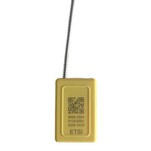
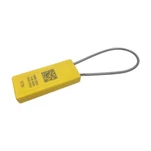
Our RFID plastic seal tag provides a compact 47.5 × 26 mm surface for electronic identification and visible marking. It can be tied or locked to tools, equipment cases, logistics containers and other items where buyers need an EPC identity together with a barcode, serial number or engraved reference.
RFID Plastic Seal Tag Specifications
The tag uses an M4E UHF chip and a compact metal-compatible PP housing. The available marking space and attachment component should be approved with the final artwork.
| Parameter | Listed Configuration |
|---|---|
| Housing dimensions | 47.5 × 26 × 2 mm |
| Antenna dimensions | 26 × 16 mm |
| RFID chip | M4E |
| Air-interface protocol | ISO 18000-6C, EPC Gen2 |
| TID / UID | 96 bits |
| EPC memory | Up to 496 bits; final allocation must be confirmed |
| User memory | 128 bits; confirm availability with the selected EPC length |
| Access password | 32 bits |
| Kill password | 32 bits |
| Operating frequency | 920.5–924.5 MHz |
| Housing material | PP, polypropylene |
| Reference read range | At least 150 cm in interference-free conditions, reader dependent |
| Installation | Tie-up, tighten, insert or locking style |
| Colors | White, blue, pink, yellow, green or customized |
| Installation environment | Metal-compatible design; validate on the final item |
| Customization | Barcode, text, embossing, laser engraving and RFID encoding |
Plan the Visible Marking Area
The 47.5 × 26 mm housing is compact. Keep variable data readable by limiting the number of elements and approving the actual-size artwork.
Human-Readable Number
Use a short serial or asset number with sufficient character height and contrast for manual inspection.
Barcode
Select a code format that fits the available surface. Test scanning after molding, printing, engraving and installation.
Logo and Text
Keep the logo and required wording secondary to the unique identifier when the available marking area is limited.
Color Identification
Use housing color for department, status or asset-group recognition without making color the only unique identifier.
Laser Engraving
Confirm contrast, character size and the variable-data file before production engraving is approved.
Embossed Information
Reserve embossing for short permanent text that remains legible within the available housing area.
Match Every Visible Code with the RFID Data
A defined relationship between printed and electronic identifiers allows buyers to use manual, barcode and UHF inspection methods without creating separate records.
| Identifier | Production Input | Verification Use |
|---|---|---|
| Visible serial number | Starting number, length, prefix and permitted characters | Manual identification when a reader is unavailable |
| Barcode | Symbology, encoded value and required dimensions | Close-range scanner identification |
| EPC | Approved hexadecimal or structured value | Primary UHF inventory identity |
| TID | Capture requirement and output-file field | Secondary chip-associated reference |
| User data | Content, encoding format and memory length | Additional application-defined information |
| Matching file | Required column order and file format | Imports production identities into the buyer's system |
Serialized Production Workflow
Approve the Format
Confirm the artwork, number range, barcode structure and EPC allocation.
Create the Data
Prepare unique visible and electronic identities using the approved rules.
Mark and Encode
Apply the visible identification and write the required RFID data.
Verify and Export
Read the finished tags and prepare the agreed matching data for delivery.
Applications for the Compact Seal Tag
Equipment Identification
Attach the tag through a fixed point on tools, instruments or equipment requiring a compact serialized identity.
Reusable Transport Cases
Identify cases and totes during dispatch, receipt, return and inventory operations.
Warehouse Containers
Connect bins or controlled packages with RFID and visible identifiers used by the warehouse system.
Cabinets and Enclosures
Use a compatible tie or locking point on doors and covers requiring identifiable seal replacement.
Metal Fixtures
Evaluate the metal-compatible construction on the final bracket, cage or equipment surface.
Multi-Site Asset Programs
Use colors, visible ranges and EPC structures to distribute serialized batches between locations.
Sample and Batch Verification
| Check | Sample Approval | Batch Inspection |
|---|---|---|
| Dimensions | Confirm housing and attachment fit | Measure according to the agreed sampling plan |
| Color | Approve the physical color reference | Compare finished housings with the approved sample |
| Visible marking | Approve layout, contrast and scan result | Check legibility and serialized sequence |
| RFID data | Approve EPC and user-memory format | Read back data and screen for duplicates |
| Data matching | Confirm visible-to-electronic relationships | Compare the finished tags with the output file |
| Installed read range | Test the tag on the intended item | Use an agreed functional reading check |
Information Required for Configuration
Physical and Visible Requirements
- Item and attachment-point photographs
- Required tie or locking construction
- Housing color and logo artwork
- Serial-number and barcode format
- Expected handling environment
RFID and Order Requirements
- Country of use and reader model
- Required operating read distance
- EPC, TID and user-memory requirements
- Password and write-protection rules
- Quantity, packaging and destination
Related RFID Seal Products
Compare the housing size, attachment method, frequency, metal environment and required mechanical seal function.
RFID Plastic Seal Tag Questions
What is the difference between housing size and antenna size?
The complete PP housing measures 47.5 × 26 × 2 mm, while the listed internal antenna size is 26 × 16 mm. Use the housing dimensions for physical fit and artwork planning.
Does the quoted size include a complete cable tie?
The published dimensions describe the RFID housing. Provide the attachment photographs and required loop size so the tie or locking component can be confirmed separately.
Can a barcode and serial number fit on this tag?
They can be reviewed, but the housing is compact. Send the code format, data length and artwork so we can evaluate actual-size legibility and scanner performance.
Is 920.5–924.5 MHz suitable for every country?
No universal regional assumption should be made. Provide the countries of use and reader model so the listed 920.5–924.5 MHz configuration can be checked against the project.
Will it always read from 1.5 meters on metal?
The stated range applies to interference-free reference conditions. Installed performance depends on the metal geometry, mounting position, reader, antenna, power setting and tag orientation.
Can the EPC match the visible serial number?
Yes. They can follow a direct numbering relationship or be connected through a matching file. Approve the data rules before marking and encoding begin.
Does the access password encrypt the stored data?
An EPC Gen2 access password controls certain tag operations but is not equivalent to cryptographic authentication or encrypted communication. State stronger security requirements separately.
What information is required for pricing?
Please provide the application, attachment photographs, country of use, reader model, EPC format, visible-number and barcode requirements, artwork, color, quantity and destination.
Configure the Marking and RFID Data Together
Send us your attachment photos, visible-number format, barcode data, EPC structure, artwork and quantity. We will review the physical fit and serialized production requirements.
Request an RFID Seal Tag QuoteHot Tags: rfid plastic seal tag, China rfid plastic seal tag manufacturers, suppliers, factory, rfid monitoring seal, rfid seal for application software, rfid seal for optical drives, rfid seal for security systems, rfid seal for solar panels, rfid security seal