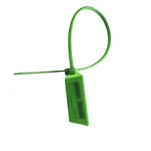
Our RFID truck seal combines a compact ABS tag housing, wire-seal installation and four electronic conditions for cargo-door inspection. Fleet operators can link each seal to a truck, trailer, driver and delivery record before departure and verify it at controlled route stops.
RFID Truck Seal Specifications
The CAB0 configuration supports 902–928 MHz transport projects requiring electronic seal identity, status verification and compact on-tag data.
| Specification | Listed Configuration | Fleet Project Requirement |
|---|---|---|
| Tag dimensions | 133 × 38 × 16 mm | Check clearance around the truck-door latch. |
| Antenna dimensions | 92 × 26 mm aluminum antenna | Confirm orientation near the metal door and frame. |
| RFID chip | CAB0 | Verify status commands with the reader software. |
| Protocol | ISO 18000-6C Gen2 V2 | Use compatible UHF readers and integration tools. |
| TID/UID | 112 bits | Define whether TID is captured when issued. |
| EPC memory | 196 bits | Provide the fleet seal-number structure. |
| User memory | 512 bits in User File 0 | Define the data fields and update permissions. |
| Reserved memory | 112 bits | Confirm password and access-control procedures. |
| Operating frequency | 902–928 MHz | Confirm compatibility with the operating country. |
| Housing | ABS plastic | Provide road, storage and cleaning conditions. |
| Reference read range | Up to 6 m in unobstructed conditions | Test on the actual truck and reader lane. |
| Installation | Wire-seal mounting | Confirm latch holes, wire length and diameter. |
| Seal function | Four electronic conditions | Define the fleet response for every condition. |
Check the Truck Seal at Four Operating Stages
Seal Inventory
The unused seal is registered and available for assignment to a truck or trailer.
Vehicle Released
The wire is installed and the seal is active on the assigned cargo door.
Door Access Exception
The reported condition requires comparison with authorized route and delivery events.
Repeated Exception
The configured reader reports another tamper-related condition requiring investigation.
Create a Truck-Specific Seal Record
The seal record should identify more than the cargo. It must show which vehicle carried the seal, who installed it and when access was permitted.
| Record Field | Required Relationship | Fleet Management Use |
|---|---|---|
| Electronic seal identity | EPC and optional TID for the issued seal | Distinguishes the installed seal from replacements. |
| Truck or tractor ID | Vehicle registration or internal fleet number | Identifies the vehicle responsible for the movement. |
| Trailer ID | Assigned trailer or cargo-body number | Preserves the record if tractor and trailer separate. |
| Driver or carrier | Authorized person or transport company | Supports custody and handover verification. |
| Route and stops | Approved origin, destination and access points | Distinguishes expected opening from an exception. |
| Cargo reference | Shipment, manifest or delivery-order number | Connects seal status with the transported goods. |
Control the Seal from Loading to Delivery
Load and Assign
Match the seal, truck, trailer, driver and cargo after loading is complete.
Lock and Verify
Install the wire and confirm the expected locked condition before gate release.
Inspect on Route
Check the RFID state and visible wire condition at authorized transfer points.
Receive and Close
Record the final condition before opening and close the seal's active record.
Fit the Wire Seal to the Cargo Door
| Truck Detail | Measurement or Check | Required Result |
|---|---|---|
| Latch opening | Measure the smallest hole used by the wire. | The cable passes through without modifying the latch. |
| Wire route | Measure the complete path with doors closed. | The wire closes with limited, visible slack. |
| Door movement | Check vibration, latch movement and road operation. | Normal movement does not create unintended damage. |
| Housing position | Check clearance around handles, hinges and bars. | The housing remains visible and protected. |
| Metal orientation | Identify the door, frame and reader approach direction. | The installed tag meets the required read reliability. |
| Removal point | Define the authorized cutting tool and safe position. | The truck can be opened without damaging the latch. |
Truck and Fleet Applications
Box Trucks
Seal compatible rear or side cargo doors for warehouse-to-customer deliveries.
Truck Trailers
Link the seal with the trailer ID even when the tractor changes during transport.
Distribution Fleets
Verify cargo-door status during dispatch, cross-dock handling and final receipt.
High-Value Deliveries
Create a documented seal record for loads requiring controlled custody.
Bonded Vehicles
Support electronic seal checks within approved bonded-transport procedures.
Rental or Contract Carriers
Associate the temporary vehicle and driver with the shipper's seal record.
Define the Action for Each Gate Result
| Gate Result | System Comparison | Fleet Action |
|---|---|---|
| Expected locked seal | Seal, truck, trailer and trip match | Release or receive the vehicle. |
| Unexpected electronic state | Identity matches but condition does not | Move the truck to an inspection area. |
| Unknown seal | No active assignment exists | Check dispatch documents before entry. |
| Wrong truck assignment | Seal belongs to another vehicle or trip | Stop processing and investigate the mismatch. |
| Unreadable seal | Electronic identity is unavailable | Repeat the read and inspect visible data. |
| Authorized opened load | Opening matches an approved delivery event | Close the old record and issue a new seal if needed. |
Validate the RFID Lane with Real Vehicles
Vehicle Speed
Test the minimum and maximum gate speeds used during normal fleet operation.
Antenna Position
Aim coverage at the truck-door seal while limiting reads from adjacent lanes.
Seal Orientation
Keep the installed housing in a repeatable position across the approved truck types.
Vehicle Materials
Test metal doors, insulated bodies and other constructions used by the fleet.
Multiple Tags
Check whether cargo RFID tags or nearby vehicles create unintended transactions.
Exception Reading
Provide a handheld procedure for trucks that cannot be verified automatically.
Printing, Encoding and Fleet Data
Visible Identification
- Human-readable seal number
- Barcode or QR code
- Fleet or carrier logo
- Variable route identifier
RFID Encoding
- 196-bit EPC configuration
- 512-bit User File 0 data
- TID capture where required
- Encoding readback verification
Fleet Integration
- Truck and trailer mapping
- Driver and trip assignment
- Four-state response rules
- Electronic mapping file
Information Needed for Configuration
Truck and Closure Details
- Truck, trailer and cargo-door types
- Latch photographs and hole dimensions
- Required wire length and diameter
- Seal position and nearby metal
- Road and handling conditions
RFID and Fleet Details
- 902–928 MHz operating country
- Reader, antenna and software models
- Four-state operating rules
- EPC, user data and artwork
- Quantity and delivery destination
Related RFID Vehicle Seals
Compare electronic states, regional frequency, wire fit, memory and reader deployment before choosing another RFID vehicle seal.
RFID Truck Seal Questions
What do the four RFID truck seal states mean? +
The listed states are UNLOCKED, LOCKED, TAMPERED and TAMPER-TRIES. Their commands, transitions and displayed meanings should be verified with the selected reader and fleet software.
Does the RFID seal continuously track the truck? +
No GPS or cellular function is listed. The system records a location when a reader detects the seal at a known site or when the EPC is associated with another fleet-tracking record.
Is the six-meter reading range guaranteed at a gate? +
No. Up to 6 m is a reference value. Vehicle speed, antenna position, reader power, metal doors, tag orientation, interference and adjacent RFID tags affect the achieved range.
Can this 902–928 MHz seal be used in Europe? +
The listed model operates at 902–928 MHz. European fleet projects generally require a different regional configuration and compatible reader settings, which must be confirmed before ordering.
Can the truck and trailer IDs be stored on the tag? +
Compact fields may be written within the 512-bit user memory. Larger fleet, route and cargo records should remain in the backend and be linked through the EPC.
Does a tampered state automatically notify the dispatcher? +
A compatible reader must obtain the seal state. The connected fleet software determines whether to block the vehicle, display a warning or notify the dispatcher.
Can the RFID truck seal be reused? +
A breached sealing element should not be treated as a new intact seal. Confirm the supplied construction and establish a replacement procedure after delivery or authorized door opening.
What information is required for a quotation? +
Please provide truck and trailer types, latch photographs, wire dimensions, operating country, reader models, four-state workflow, EPC and user data, artwork, quantity and destination.
Configure the RFID Seal for Your Fleet
Send us the truck and trailer types, latch dimensions, operating region, reader setup, state rules, EPC and user data, artwork and quantity for configuration review.
Request an RFID Truck Seal ReviewHot Tags: rfid truck seal, China rfid truck seal manufacturers, suppliers, factory, rfid seal for bakery products, rfid seal for connectors, rfid seal for mobile phones, rfid seal for payroll software, rfid seal for power plants, rfid seal for wind turbines