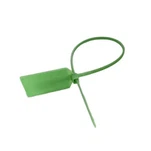
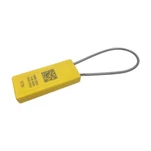
Our RFID cable seal combines a compact ABS housing, G2IL+ UHF chip and flexible locking installation for secured doors, cages, cases and transport units. Its value depends on selecting the correct cable arrangement, applying it consistently and recording every authorized removal or replacement.
RFID Cable Seal Specifications
The passive, battery-free configuration supports a moderate UHF reading zone and a simple EPC-based identification workflow.
| Specification | Listed Configuration | Selection Requirement |
|---|---|---|
| Seal dimensions | 133 × 38 × 16 mm | Check clearance and handling space. |
| Chip | G2IL+ | Confirm reader and command support. |
| TID/UID | 64 bits | Define whether TID is captured. |
| EPC memory | 128 bits | Approve the seal identifier format. |
| User memory | No user memory | Keep project data in the backend. |
| Reserved memory | 32-bit access and 32-bit kill | Define password custody. |
| Operating frequency | 860–960 MHz | Confirm regional reader settings. |
| Reference read range | Up to 6 m in free air | Test on the secured equipment. |
| Housing | ABS plastic | Validate the operating environment. |
| Installation | Tie, tighten, insert or locking style | Specify the cable and closure interface. |
| Color | Yellow or customized | Define the color-control purpose. |
| Characteristic | Tamper detection | Verify the supported reader response. |
Specify the Cable Around the Closure
Cable Diameter
Match the cable to the smallest eyelet, hasp or locking aperture through which it must pass.
Usable Length
Allow enough length for routing and locking without leaving an excessive loop that weakens control.
Bend and Pull Direction
Check that the route does not force sharp bends or continuous loads into the housing.
Match the Installation to the Protected Access Point
| Access Point | Fit Check | Installation Objective | RFID Check |
|---|---|---|---|
| Truck or trailer door | Latch aperture and cable route | Bridge the controlled opening | Test beside the vehicle structure |
| Cargo cage | Mesh size, gate and hinge movement | Prevent gate opening without removal | Check metal-frame detuning |
| Transit case | Handle, eyelet or clasp dimensions | Secure the intended lid or panel | Test with the packed contents |
| Utility cabinet | Door gap and service clearance | Identify authorized access events | Verify near equipment and wiring |
| Storage container | Hasp geometry and opening route | Secure the selected access point | Measure the installed read zone |
Apply the Seal With a Repeatable Procedure
Verify
Read the EPC and compare the visible identity with the assigned record.
Route
Pass the cable through every component required to secure the access point.
Lock
Tighten to the documented loop size and confirm full engagement.
Record
Store the asset, operator, time, EPC and post-installation result.
Control Authorized Removal and Replacement
| Removal Step | Required Action | Record to Capture | Risk Controlled |
|---|---|---|---|
| Pre-opening verification | Read and inspect the installed seal | EPC, visible code and result | Opening the wrong secured unit |
| Authorization | Confirm the responsible person and reason | Approver, location and time | Uncontrolled seal removal |
| Cable cutting | Use the approved tool and safe direction | Removal method and condition | Injury or asset damage |
| Seal closure | Remove the identity from active use | Final disposition and operator | Accidental record reuse |
| Replacement | Assign and verify a new seal if required | Old and new identity relationship | Broken custody history |
Plan RFID Data Around EPC Memory
On the Tag
- 128-bit primary EPC identity
- 64-bit TID chip reference
- Access and kill passwords
- No user-memory allocation
In the Database
- Asset or shipment relationship
- Application and removal events
- Operator and facility identity
- Inspection and exception history
On the Housing
- Human-readable serial number
- Barcode or QR code
- Company logo and text
- Yellow or customized color
Complete Applied-Sample Testing
Fit Test
Check cable passage, loop size, locking action and housing clearance.
Handling Test
Reproduce vibration, movement and routine handling of the secured unit.
RFID Test
Measure the actual read zone with the specified reader and orientation.
Removal Test
Confirm the approved cutting tool, safe access and replacement procedure.
Information Needed for Cable Seal Selection
Mechanical Requirements
- Protected item and closure photographs
- Smallest opening diameter
- Required cable diameter and length
- Expected movement and pull direction
- Removal tool and access procedure
RFID and Order Requirements
- Deployment countries and UHF bands
- Reader and antenna models
- EPC and printed-code structure
- Color, artwork and encoding data
- Quantity and destination country
Related RFID Cable and Wire Seals
Compare cable fit, housing size, chip memory, reading zone and detection requirements before selecting another RFID seal.
RFID Cable Seal Questions
What cable dimensions should be specified? +
Provide the smallest closure opening, required loop path, usable length, bend limits and expected pull direction. Photographs with dimensions help confirm the mechanical interface.
Does the tag store user-defined shipment data? +
The listed G2IL+ configuration has no user memory. Store detailed shipment, asset and event data in the backend system linked through the 128-bit EPC.
Will the tag always read from six metres? +
No. Six metres is a free-air reference maximum. Actual range depends on the reader, antenna, power, orientation, nearby materials, installation and radio environment.
Can one tag configuration operate worldwide? +
The tag is listed for 860–960 MHz, but reader bands, power limits and regulations vary. Confirm every deployment country and test the final reader settings.
Does an EPC read prove that the seal is intact? +
An EPC read confirms the presence of a responding identity. Integrity decisions should also use the supported detection result, cable and housing inspection, assignment record and workflow stage.
How should the cable seal be removed safely? +
Use an approved tool suited to the confirmed cable construction, isolate the cutting direction from personnel and equipment, and record the seal identity before removal.
What information is required for a quotation? +
Please provide closure photographs and dimensions, cable diameter and length, deployment countries, reader models, EPC format, color, artwork, encoding data, quantity and destination.
Match the Cable Seal to Your Closure
Send us the protected access point, closure dimensions, cable requirement, deployment region, reader setup, EPC rules, color, artwork, encoding data and quantity for review and pricing.
Request a Cable Seal ReviewHot Tags: RFID cable seal, China RFID cable seal manufacturers, suppliers, factory, rfid seal for demultiplexers, rfid seal for drawers, rfid seal for eyewear, rfid seal for switches, rfid seal for tools, rfid tracking seal