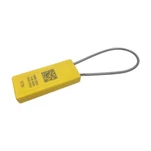
Our plastic padlock seal combines an ABS and PC lock body, a 4 mm stainless steel shackle and an integrated 13.56Mhz electronic identity. Its compact format suits cabinets, equipment enclosures, storage units and other closures that require physical locking with digital identification.
Plastic Padlock Seal Specifications
Use the mechanical dimensions and environmental ratings to confirm physical fit, then define the required NFC chip, protocol, memory and reading equipment for the project.
| Specification | Listed Configuration | Order Requirement |
|---|---|---|
| Lock body material | ABS and PC | Confirm exposure and handling conditions |
| Lock shackle material | 304 stainless steel | Check the closure material and environment |
| Lock body size | 45 × 40 × 18 mm | Verify clearance around the locking point |
| Shackle diameter | 4 mm | Measure the hasp or attachment hole |
| Net weight | 40 g | Check suitability for the protected closure |
| Operating frequency | 13.56Mhz | Select the frequency for the destination market |
| RFID configuration | Chip, protocol and memory to be confirmed | Provide reader and data requirements |
| Operating temperature | −30 to +70°C | Compare with normal service conditions |
| Storage temperature | −40 to +85°C | Confirm warehouse and transport exposure |
| Enclosure protection | IP65 | Define water, dust and cleaning exposure |
| Relative humidity | 0–95% | Confirm whether condensation may occur |
Use the Seal as a Controlled Asset Identifier
The padlock format supports a workflow in which the physical lock, protected asset and RFID record are assigned and checked together.
Register
Create the lock record and associate its electronic identifier with a specific asset or closure.
Install
Pass the 4 mm shackle through the approved attachment point and complete the locking action.
Read
Use the approved NFC device and read zone to retrieve the assigned lock identity.
Reconcile
Compare the physical lock, asset record and expected status during inspection or handover.
Match the Lock to the Protected Item
| Application | Mechanical Check | RFID Check | Record to Maintain |
|---|---|---|---|
| Equipment cabinet | Hasp diameter, spacing and door clearance | Read access near surrounding metal | Cabinet ID, location and responsible team |
| Storage locker | Latch geometry and shackle movement | Reader position within the inspection route | Locker assignment and inspection status |
| Tool or equipment case | Attachment-hole size and handling loads | Read performance when cases are stacked | Case contents, custodian and return status |
| Utility enclosure | Weather exposure and fitting strength | Antenna response at the installed angle | Site, service interval and inspection result |
| Warehouse cage | Latch fit and available lock clearance | Read-zone separation from adjacent locks | Zone, inventory group and access status |
Define the RFID Reading Method
Reader type, antenna placement and the installed environment determine how reliably each seal can be identified.
Handheld Inspection
Use a NFC reader for scheduled rounds, exception checks and lock-to-asset reconciliation.
Fixed Read Point
Define a controlled antenna zone when locks pass a gate, service counter or equipment checkpoint.
Single-Lock Verification
Reduce reader power or use close positioning when operators must distinguish one lock from nearby RFID items.
Create a Clear Identification System
Electronic Data
- Required chip and protocol
- EPC or other encoded identifier
- User-memory requirement
- Encoding and verification file
Visible Identification
- Lock number or asset number
- Barcode or QR code
- Logo and operating text
- Color by site, team or status
Database Relationship
- RFID ID matched to printed number
- Lock matched to protected asset
- Issue and return status
- Replacement and retirement history
Test the Installed Configuration
Fit Test
Confirm that the shackle passes through the closure and leaves adequate operating clearance.
Lock Test
Complete the specified locking procedure and inspect the body, shackle and attachment point.
Read Test
Measure identification performance with the intended reader at the actual installation position.
Record Test
Verify that the electronic ID, visible number and asset record correspond without duplication.
Information Needed for Configuration
Lock and Environment
- Closure type and application photographs
- Attachment-hole diameter and spacing
- Nearby metal and installation orientation
- Operating and storage conditions
- Required color and visible marking
RFID and Data
- Destination frequency requirement
- Chip, protocol and memory requirement
- Reader model and antenna arrangement
- Encoding and printed-number relationship
- Quantity and destination country
Related RFID Security Seals
Compare the padlock format with cable, wire and pull-tight seals according to closure geometry, inspection method and required evidence of opening.
Plastic Padlock Seal Questions
What RFID chip and memory does the seal use? +
Provide the required reader, data structure and regional frequency so we can review the configuration.
What reading distance should buyers expect? +
It depends on the confirmed chip and antenna, reader power, antenna gain, orientation, nearby metal and installation environment.
Can it fit an existing cabinet or enclosure? +
Measure the attachment hole, hasp spacing, available shackle movement and clearance for the 45 × 40 × 18 mm body. Application photographs help us review the fit.
Does IP65 make the lock suitable for every outdoor site? +
IP65 describes enclosure protection against dust and water jets under defined test conditions. Evaluate immersion, condensation, chemicals, UV exposure and mechanical loads separately.
Can visible numbers be matched with RFID data? +
Matching electronic and visible identifiers can be reviewed as part of the project. Provide the number format, variable-data file, barcode requirements and required output record.
What information is required for a quotation? +
Please provide the closure dimensions, environment, frequency market, RFID chip or memory requirement, reader model, printing, encoding, color, quantity and destination country.
Match the Padlock Seal to Your Closure and Reader
Send us the closure photographs, attachment dimensions, operating environment, destination frequency, reader model, RFID data, visible marking and quantity for configuration review and pricing.
Request a Padlock Seal ReviewHot Tags: plastic padlock seal, China plastic padlock seal manufacturers, suppliers, factory, rfid seal for laptops, rfid seal for mobile phones, rfid seal for oil and gas, rfid seal for warehouse, rfid seal for waste management, rfid seal for window locks