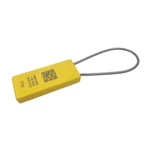
Our tamper proof wire seals combine a galvanized steel cable, IP66 ABS housing, on-metal UHF antenna and electronic detection states. The 421 × 50 × 19 mm construction is designed for long-range inspection of commercial containers, cargo and controlled assets.
Tamper Proof Wire Seal Specifications
The CAB1/VBL7-NC configuration adds 192-bit EPC memory, 512-bit user memory and electronic status detection for projects requiring more than basic seal identification.
| Specification | Listed Configuration | Project Requirement |
|---|---|---|
| Seal dimensions | 421 × 50 × 19 mm | Check the complete wire route and housing clearance. |
| Antenna dimensions | 98 × 36.7 mm | Confirm orientation relative to metal and reader antennas. |
| RFID chip | CAB1/VBL7-NC | Verify chip commands with the intended software. |
| Protocol | ISO 18000-6C Gen2 V2 | Use compatible UHF readers and integration tools. |
| Operating frequency | 902–928 MHz | Confirm that the operating market uses this band. |
| TID/UID | 112 bits | Define whether TID is captured during commissioning. |
| EPC memory | 192 bits | Provide the required seal-number structure. |
| User memory | 512 bits in User File 0 | Submit the required data fields and encoding format. |
| Reserved memory | 112 bits | Define password and access-control procedures. |
| Housing and cable | ABS housing and galvanized steel wire | Check closure dimensions and authorized removal tools. |
| Reference read range | Up to 15 m on metal | Validate the applied seal at the intended checkpoint. |
| Installation | Tie-up, tighten, insert or lock | Document the approved installation sequence. |
| Housing colors | Yellow, red, green or customized | Specify color coding and visible identification. |
| Protection and use | IP66, on-metal, detection sensor | Test sealing and electronic status behavior. |
Use Electronic States to Support Seal Inspection
The sensor-enabled chip can provide electronic condition information when interrogated by a compatible reader. The software must translate each returned state into an operational decision.
Before Installation
Confirm the initial electronic state and assign the EPC to the correct shipment or asset.
After Locking
Read the installed seal and store its expected locked condition in the management system.
During Inspection
Compare electronic status, EPC and visible cable condition at each controlled checkpoint.
After Opening
Record the final state, authorized operator, location and physical evidence before disposal.
Define the Result for Every Seal Condition
| Seal Condition | Inspection Result | System Action | Physical Follow-Up |
|---|---|---|---|
| Unassigned seal | Valid tag with no active asset record | Keep the seal in controlled inventory | Inspect the cable and housing before issue |
| Expected locked seal | Identity and electronic state match | Record the successful checkpoint event | Check the wire, housing and printed number |
| Unexpected state | Returned status differs from the expected record | Create an exception for investigation | Inspect for opening, damage or installation error |
| Wrong identifier | EPC does not match the assigned shipment | Stop automatic approval | Compare the visible and electronic numbers |
| Unreadable seal | No reliable response in the approved reading zone | Record a read exception | Repeat the read and inspect visible condition |
| Authorized opening | Access has been approved and documented | Close the active seal record | Retain evidence according to site procedure |
Plan Long-Range Reading Around Metal Cargo
The up-to-15 m specification supports larger reading zones, but reliable identification depends on antenna placement, tag orientation, reader settings and site traffic.
Container Gate
Position reader antennas to identify the intended seal while limiting reads from adjacent lanes or parked containers.
Loading Dock
Create a controlled zone for verifying the assigned seal before loading, dispatch or receiving.
Container Yard
Account for metal reflections, stacked cargo, vehicle movement and multiple tags in the reader field.
Warehouse Exit
Match the seal identity and status with the released cargo before it leaves the controlled area.
Handheld Exception Check
Use a compatible handheld reader for close inspection when a fixed checkpoint reports an exception.
Outdoor Storage Area
Evaluate housing exposure, cable routing and reader coverage under the actual installation conditions.
Match the Seal to the Protected Closure
| Fit Area | Measurement or Check | Required Outcome |
|---|---|---|
| Wire opening | Measure each hole or slot in the locking route. | The supplied cable passes through without modification. |
| Total wire route | Measure around all secured handles and fixtures. | The seal reaches and tightens with controlled slack. |
| Housing position | Check clearance around doors, latches and hinges. | The 50 × 19 mm housing remains visible and protected. |
| Antenna orientation | Determine the normal direction of reader approach. | The antenna faces the planned reading zone. |
| Metal environment | Identify the backing surface and nearby structures. | The applied seal meets the required read reliability. |
| Authorized removal | Define the cutting tool and safe access point. | The closure can be opened without damaging the asset. |
Applications for RFID Wire Seals
Commercial Containers
Combine physical wire sealing with long-range electronic inspection at logistics checkpoints.
High-Value Cargo
Connect the protected shipment with a unique identity and defined status-response procedure.
Cold-Chain Loads
Secure compatible closures after validating housing, cable and RFID performance in the operating environment.
Customs Supervision
Support electronic seal checks within the authority's approved inspection and database workflow.
Outdoor Equipment
Protect compatible metal cabinets, access covers and industrial assets with an IP66 housing.
Bonded Warehouses
Verify seal identity and condition as controlled cargo enters, remains in or leaves storage.
Use EPC and User Memory for Different Data
EPC Identification
- Electronic seal number
- Customer-defined coding structure
- Printed-to-electronic matching
- Database record lookup
User File 0
- Approved compact data fields
- Application-specific status data
- Encoding within 512 bits
- Reader-software compatibility
Backend Record
- Shipment and asset assignment
- Reader event history
- Personnel and location records
- Exception investigation results
Printing, Encoding and Color Options
Visible Data
- Company name or logo
- Human-readable seal number
- Barcode or QR code
- Variable shipment identifier
Electronic Configuration
- 192-bit EPC encoding
- 512-bit user-file encoding
- TID capture where required
- Data readback verification
Housing Configuration
- Yellow housing
- Red housing
- Green housing
- Confirmed customized color
Information Needed for Configuration
Physical Seal Requirements
- Container, cargo or equipment type
- Closure photographs and dimensions
- Available wire path and housing position
- Environmental and cleaning conditions
- Authorized installation and removal method
RFID System Requirements
- 902–928 MHz operating country
- Reader, antenna and software models
- Required electronic state workflow
- EPC, user-memory and printing data
- Quantity and delivery destination
Related RFID Security Seals
Compare frequency, electronic states, user memory, protection rating, cable fit and reading distance before selecting another security seal.
Tamper Proof Wire Seal Questions
What do the electronic seal states represent? +
The sensor-enabled chip can return condition information for use by compatible readers and software. The exact state mapping, commands and operational response should be confirmed during integration testing.
Does the seal send a real-time alarm without a reader? +
No. The passive RFID seal requires a compatible reader to obtain its identity and available status. Reader software or a connected management platform must generate any notification or alarm.
Is the 15 m on-metal reading distance guaranteed? +
No. Up to 15 m is a reference value. Reader power, antenna gain, orientation, metal geometry, interference, tag population and installation conditions affect the achieved range.
Can this seal be used outside the 902–928 MHz region? +
The listed configuration operates at 902–928 MHz. Projects in other UHF regions require confirmation of tag tuning, permitted reader channels and local radio regulations before ordering.
What can be stored in the 512-bit user memory? +
It can hold a compact application-specific record that fits within 512 bits. Submit the final field structure, encoding method and reader-software requirements before production programming.
Does IP66 make the seal suitable for every outdoor site? +
IP66 addresses enclosure protection against dust and powerful water jets under defined test conditions. Chemical exposure, immersion, temperature cycling, UV and mechanical loads require separate evaluation.
Can the seal be read when mounted on a container? +
The product is listed for on-metal use. Applied testing is still required because container geometry, doors, locking bars, adjacent cargo and reader position influence UHF performance.
What information is required for a quotation? +
Please provide the closure photographs, wire path, operating country, environment, reader and antenna models, required status workflow, EPC and user-memory data, printing, quantity and destination.
Define the Seal States and Reading Zone
Send us the closure details, operating region, reader setup, required electronic states, EPC and user-memory format, printing and quantity for configuration review and pricing.
Request a Tamper Proof Seal ReviewHot Tags: tamper proof wire seals, China tamper proof wire seals manufacturers, suppliers, factory, rfid seal for chemicals, rfid seal for energy management, rfid seal for perishable goods, rfid seal for switches, rfid seal for voip phones, rfid tamper evident seal