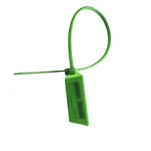
Our RFID cable seal tag is an embedded UHF module for developing a cable seal around a compact electronic housing. The 118 × 33 × 12 mm body provides the RFID identity, while cable diameter, length, locking mechanism and secured opening must be configured as part of the complete seal assembly.
Ordering scopeProvide both the RFID requirements and the mechanical cable-seal specification for model review.
RFID Cable Seal Tag Specifications
Final cable and lock requirements must be confirmed for the complete assembly.
| Item | Listed Tag Configuration | Assembly Input Required |
|---|---|---|
| RFID housing size | 118 × 33 × 12 mm | Available space in the seal body |
| Antenna size | 93 × 26 mm | Required antenna orientation |
| Chip | G2IL+ | Reader compatibility |
| Protocol | ISO 18000-6C Gen2 | UHF system requirements |
| TID or UID | 64 bits | Chip-identity matching rule |
| EPC memory | 128 bits | Seal-number encoding format |
| User memory | 0 bits | Backend data arrangement |
| Reserved memory | 32-bit access and 32-bit kill passwords | Password-management procedure |
| Frequency | 860–960 MHz | Operating countries |
| Reference range | Up to 3 m, reader dependent | Applied reading distance |
| Housing material | ABS plastic | Operating environment |
| Installation | Embedded | Retention and assembly method |
| Color | Green or customized | Required visual coding |
| Characteristic | Tamper-proof construction | Required tamper test |
Define the Cable Seal Around the RFID Housing
Cable Diameter
Match the cable with the smallest locking hole while retaining the mechanical performance required by the project.
Usable Length
Measure the full route through the protected opening and include the insertion length required by the lock.
Locking Direction
Confirm how the cable enters the housing and how operators hold the tag during installation.
Pull-Up Requirement
Define whether the installed loop must tighten close to the fitting or retain controlled free movement.
Removal Method
Specify the authorized tool, removal location and procedure for recording the used seal.
Housing Position
Keep the embedded antenna clear of avoidable impact and oriented toward the planned reader position.
Develop the Complete Seal Assembly
Measure the Fixture
Record locking-hole diameter, spacing, thickness and the required cable route.
Confirm the Cable
Select the required diameter, length, flexibility and mechanical construction.
Build the Sample
Integrate the RFID housing with the intended lock, cable and visible identification.
Test the Assembly
Check installation, retention, authorized removal, RFID response and visible evidence.
Match Cable Geometry to the Secured Opening
| Application Point | Dimensions to Measure | Assembly Concern | Sample Test |
|---|---|---|---|
| Truck or trailer hasp | Hole diameter and hasp thickness | Cable movement near the door | Install with adjacent hardware operating |
| Container locking fixture | Hole spacing and cable path | Housing contacts the locking bar | Verify final housing orientation |
| Transport cage | Mesh opening and loop length | Excess loop allows unwanted movement | Apply the expected handling loads |
| Valve or meter fitting | Wire passage and bend radius | Cable is too stiff for the route | Install without damaging the fixture |
| Secured cabinet | Latch clearance and access space | Housing obstructs normal operation | Close, read and inspect the cabinet |
Verify Mechanical and RFID Performance Together
Installation Test
- Cable passes through the fixture
- Locking direction is clear
- Housing remains accessible
- Loop length meets the requirement
Mechanical Test
- Lock retains the inserted cable
- Housing remains correctly positioned
- Handling does not loosen the assembly
- Authorized removal is practical
RFID Test
- EPC matches the printed identity
- Final orientation remains readable
- Required distance is achieved
- Nearby tags do not cause confusion
Review Assembly Failure Modes
| Observed Problem | Likely Area | Required Check | Corrective Direction |
|---|---|---|---|
| Cable will not pass | Cable diameter or fixture opening | Measure both components | Revise the cable specification |
| Cable does not retain | Lock and cable compatibility | Inspect insertion and retention | Review the complete lock design |
| Housing rotates freely | Loop length or assembly layout | Observe normal handling | Adjust position or cable length |
| Reading distance falls | Embedding or nearby materials | Compare loose and assembled readings | Revise antenna orientation or spacing |
| EPC and print differ | Variable-data sequence | Compare production mapping records | Quarantine the affected sequence |
RFID and Visible Identification Options
RFID Encoding
- Customer-defined EPC format
- Sequential encoding ranges
- TID and EPC mapping
- Read-after-write verification
Visible Marking
- Company logo and text
- Human-readable seal number
- Barcode or QR code
- Green or custom color
Order Data
- Printed-to-EPC relationship
- Specified number ranges
- Batch-separated packaging
- Electronic delivery file
Information Needed for Cable Seal Configuration
Mechanical Requirements
- Application photographs or drawings
- Locking-hole dimensions
- Required cable diameter and length
- Pull-up or fixed-loop requirement
- Removal method and operating environment
RFID Requirements
- Operating countries and UHF band
- Reader and antenna models
- Required applied read distance
- EPC and printed-data formats
- Artwork, color, quantity and destination
Related RFID Cable and Wire Seals
Compare embedded RFID components with complete cable, wire, plastic and container seal constructions.
RFID Cable Seal Tag Questions
How should the correct cable length be selected? +
Measure the full route through the protected opening, the required installed loop and the insertion length used by the locking mechanism.
Can the RFID tag be tested before the cable design is final? +
Initial RFID testing can use the tag component, but final approval should use the completed cable seal because the lock, cable, embedding and surrounding materials may affect performance.
Is the three-meter reading distance guaranteed? +
No. Three meters is a reference maximum. Reader configuration, housing orientation, embedded position, nearby materials and interference determine the applied distance.
Can detailed asset data be written into the tag? +
Use the 128-bit EPC as the reference and maintain detailed asset or shipment information in the connected database.
Can printed numbers be matched with the EPC? +
We can review sequential EPC encoding, visible numbers, barcodes or QR codes and provide the required mapping data after the final format is confirmed.
What information is required for a quotation? +
Please provide the application drawing, locking-hole dimensions, cable diameter and length, lock requirement, operating countries, reader models, target distance, EPC format, artwork, quantity and destination.
Configure the RFID Housing and Cable as One Seal
Send us your locking-point dimensions, cable specification, seal layout, reader setup, EPC format, artwork and quantity for assembly review and pricing.
Request a Cable Seal Assembly ReviewHot Tags: rfid cable seal tag, China rfid cable seal tag manufacturers, suppliers, factory, rfid seal for bakery products, rfid seal for document, rfid seal for ip cameras, rfid seal for oil and gas, rfid seal for package, rfid seal for truck