

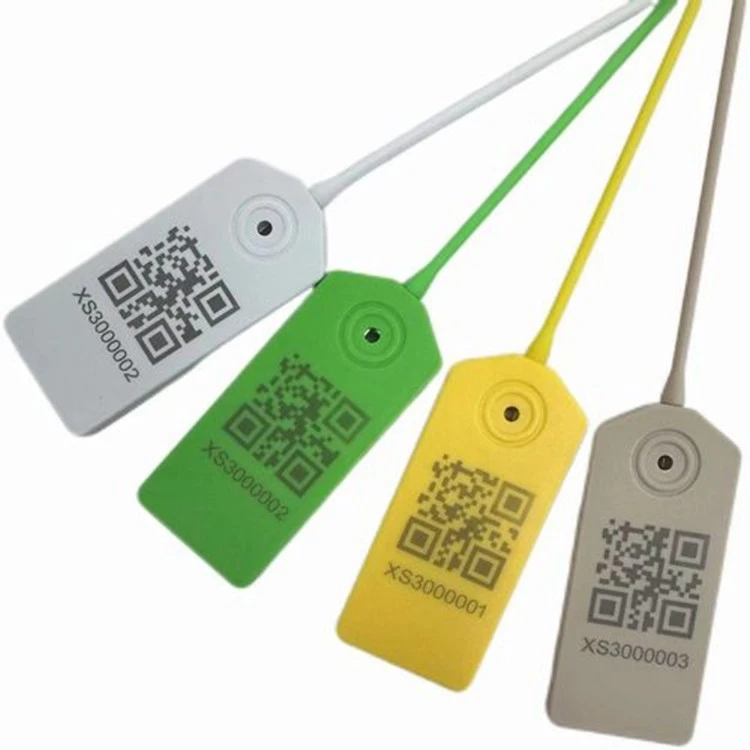
Our E-seal RFID container tag combines a unique UHF identity, rugged IP66 PC housing and optional state detection for container doors, cargo equipment and outdoor logistics operations. It supports electronic seal assignment, checkpoint reading and arrival verification within the buyer's management system.
E-Seal RFID Container Tag Specifications
Confirm the container locking position, selected sensor configuration, operating frequency and reader deployment before approving the electronic seal.
| Specification | Available Configuration | Order Requirement |
|---|---|---|
| Overall dimensions | 270 × 33.5 × 5.8 mm | Confirm the usable loop and container locking-point dimensions. |
| Chip | CAB1 or VBL7-NC | Select according to the required identity and sensor function. |
| Protocol | ISO 18000-6C Gen2 V2 | Confirm compatibility with the planned UHF infrastructure. |
| Operating frequency | 860–960 MHz | Specify the destination country and authorized reader band. |
| TID or UID | 112 bits | Define whether the system records both TID and EPC. |
| EPC memory | 192 bits | Provide the seal-number format and encoding rules. |
| User memory | 512 bits | Confirm the required fields and access permissions. |
| Reserved memory | 112 bits | State any access-password or kill-password requirements. |
| Reference read range | Up to 5 m, reader dependent | Test the installed seal at each intended checkpoint. |
| Housing | PC | Confirm impact, vibration and chemical exposure. |
| Ingress protection | IP66 | Match the stated rating to the operating environment. |
| Installation | Hanging style | Provide photographs and measurements of the locking point. |
| Environment | On-metal and outdoor use | Verify orientation on the actual container hardware. |
| Color | Green, red, white or customized | Define any route or status color classification. |
| Additional functions | Temperature or detection sensor | Confirm the required measurement or trigger behavior. |
Connect the Physical Seal to the Container Record
The electronic identity must be assigned to the correct container, shipment and journey before dispatch.
Assign the Seal
Associate the EPC and TID with the container number, booking reference and approved shipment record.
Apply and Verify
Install the seal at the approved door position and confirm the initial RFID and sensor state.
Read at Handover
Capture the seal identity and available status at defined terminal, depot or warehouse checkpoints.
Inspect on Arrival
Compare the received identity, physical condition and electronic status with the dispatch record.
Plan Each Container Checkpoint
| Checkpoint | Data to Capture | Required Action | Exception to Review |
|---|---|---|---|
| Seal assignment | Container number, EPC, TID and shipment reference | Verify the electronic and visible identifiers | Duplicate or unmatched seal identity |
| Loading completion | Applied seal ID, operator and initial status | Confirm correct installation and readability | Incorrect seal, failed reading or abnormal status |
| Depot handover | Seal ID, time and transfer location | Match the received container to the expected record | Unknown seal or unexpected status change |
| Port or terminal | Container and seal identity at entry or exit | Apply the operator's release and routing rules | Missing read or record mismatch |
| Destination arrival | Final identity, status and physical condition | Authorize opening through the buyer's procedure | Changed identity, damaged seal or inconsistent status |
| Controlled opening | Opening operator, time and final seal state | Close the shipment record | Opening outside the authorized process |
Use the E-Seal Across Cargo Operations
Freight Forwarding
Link each container seal to the forwarding record and verify its identity during transfer between operating partners.
Container Depots
Read electronic seal identities during container release, return and yard handling after the workflow is integrated.
Warehouse Dispatch
Confirm the assigned container and seal before a loaded shipment leaves the distribution facility.
Terminal Handover
Compare the presented seal identity with the expected transport record at controlled entry or transfer points.
High-Value Cargo
Add an electronic identity and optional state detection to the buyer's existing cargo-control procedure.
Customs Supervision
Configure the seal and data workflow to the applicable authority, tender and operating requirements.
Define the Detection and Temperature Functions
Select the sensor configuration only after the required event, measurement method and software response have been documented.
| Function | Project Definition | Acceptance Test |
|---|---|---|
| Seal identity | Specify the EPC and TID relationship with each container. | Read and reconcile every encoded sample. |
| Initial state | Define the electronic condition expected after installation. | Apply the seal and capture its starting status. |
| Detection event | State the physical action that should trigger a status change. | Perform the approved opening or tamper simulation. |
| Status retention | Confirm whether the event remains available after the trigger. | Read the seal again after the controlled event. |
| Temperature sensing | Specify range, accuracy, measurement timing and reader method. | Compare readings under controlled temperature conditions. |
| System response | Define valid, opened, unknown and unreadable outcomes. | Verify each response in the connected software. |
Select the Reader Deployment
Handheld Verification
Operators can verify a specific container during sealing, inspection or arrival. Test selection accuracy when multiple tagged containers are nearby.
Controlled Gate Reading
Fixed UHF equipment may capture seals at a defined gate after lane width, vehicle speed and antenna placement are validated.
Loading-Bay Check
A controlled loading position can confirm the electronic seal before dispatch or after receipt at a warehouse.
Printing, Serialization and RFID Encoding
We can review the visible seal number and electronic identity together to support reconciliation at each cargo handover.
Visible Identification
- Mono or color barcode
- Container or shipment reference
- Laser-engraved serial number
- Text embossing and custom color
Electronic Data
- Customer-defined EPC structure
- TID and EPC association
- User-memory data if required
- Password configuration and verification
Data Reconciliation
- Printed and encoded ID matching
- Duplicate-number control
- Variable-data file review
- Finished encoding output format
Information Needed for Configuration
Container and Route Details
- Container type and locking-point photographs
- Available opening and installation dimensions
- Route, checkpoints and handover process
- Outdoor, impact and chemical exposure
- Required physical opening procedure
RFID and System Details
- Operating country and UHF frequency
- Handheld or fixed reader models
- Required detection or temperature function
- EPC, barcode and data-matching rules
- Color, quantity and destination country
Related RFID Container Security Products
Compare the attachment structure, sensor behavior, read range and container-door fit before selecting an RFID security seal.
E-Seal RFID Container Tag Questions
Does this E-seal fit every container door? +
No universal fit should be assumed. The listed size is 270 × 33.5 × 5.8 mm, but the usable attachment range and clearance must be checked against the actual container locking point.
Does the seal automatically report its location? +
The UHF tag does not provide autonomous GPS location reporting. Location information normally comes from the known reader or checkpoint where the seal is read.
Can it detect unauthorized container opening? +
A compatible detection configuration can provide a defined electronic status change. The exact trigger, state retention and reader response must be confirmed and tested for the selected model.
Is the 5 m reading range guaranteed? +
No. Up to 5 m is a reference distance. Reader power, antenna placement, container metal, seal orientation, vehicle position and radio interference affect actual performance.
Can the tag record a complete temperature history? +
Historical logging should not be assumed. Confirm the sensor chip, temperature range, accuracy, sampling behavior, memory capacity and interrogation method required by the project.
Can it replace a certified high-security bolt seal? +
Do not treat an electronic cable-style seal as a replacement for a required certified bolt seal unless the applicable authority, tender or operating standard explicitly approves that configuration.
Can the E-seal be reused after opening? +
The page describes it as a disposable sealing product. The selected sample should be tested to confirm the physical removal method and electronic state after authorized opening.
What information is required for a quotation? +
Please provide the container type, locking-point photographs and dimensions, route checkpoints, detection or temperature requirements, operating country, reader models, encoding rules, color, quantity and destination.
Configure an E-Seal for Your Container Workflow
Send us the container locking position, route checkpoints, required detection or temperature function, reader models, frequency region, encoding rules and quantity for configuration review and pricing.
Request an E-Seal Configuration ReviewHot Tags: e seal rfid container tag, China e seal rfid container tag manufacturers, suppliers, factory, rfid seal for application software, rfid seal for fpgas, rfid seal for hazardous materials, rfid seal for lumber, rfid seal for project management systems, rfid seal for solar panels


