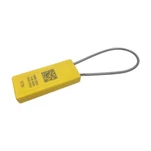
Our RFID truck seals tag is a 297 mm passive UHF locking seal for one-trip vehicle and cargo assignments. The printed seal number, EPC and issue record can be prepared as a matched set for dispatch control, driver acceptance and authorized seal cancellation.
Designed for trip-specific locking where the complete seal is issued against one transport record.
RFID Truck Seals Tag Specifications
Confirm the vehicle closure, UHF system and seal-issue data before selecting the production configuration.
| Item | Listed Configuration | Fleet Input |
|---|---|---|
| Seal dimensions | 297 × 59 × 20 mm | Clearance around the truck-door hardware |
| Copper antenna | 50.6 × 29.6 mm | Housing orientation during inspection |
| Chip | G2IL+ | Reader and software compatibility |
| Protocol | ISO 18000-6C Gen2 | Compatible fixed or handheld equipment |
| TID or UID | 64 bits | Required chip-identity verification rule |
| EPC memory | 128 bits | Trip or seal-issue coding format |
| User memory | 0 bits | Backend storage for trip details |
| Reserved memory | 32-bit access and 32-bit kill passwords | Password ownership and authorization |
| Operating frequency | 860–960 MHz | Countries included in the vehicle route |
| Reference read range | Up to 6 m, reader dependent | Required inspection distance |
| Construction | ABS housing and galvanized steel cable | Truck-door locking-point dimensions |
| Installation | Locking style | Issue, locking and removal procedure |
| Colors | Yellow, red, green or customized | Carrier, depot or route identification |
| Detection | Detection sensor | Exception-screening workflow |
Choose the Correct Truck Seal Format
This model is intended for a different operating method from compact housings with replaceable cable components.
297 mm Locking Seal
Use when the complete physical seal is assigned to a specific journey and controlled through issue, use and cancellation records.
Passive UHF Operation
Use when battery-free RFID identification within a validated moderate reading zone meets the project requirement.
Printed and EPC Pairing
Use when drivers and inspectors need both human-readable identification and electronic verification.
One-Trip Accountability
Use when each issued seal number must be consumed, returned unused or recorded as an exception.
Control Seal Issue to Drivers
A seal inventory process prevents unused, damaged or incorrectly assigned seals from disappearing outside the transport record.
Pick
Select an available seal from the approved batch and verify its printed identity.
Assign
Link the seal with the vehicle, trailer, driver, load and planned destination.
Acknowledge
Record that the driver or loading operator received the correct unused seal.
Consume
Mark the identity as installed, unused-returned, damaged or otherwise accounted for.
Match the Seal to Mixed Fleet Hardware
| Vehicle Closure | Fit Check | Installation Risk | Approval Test |
|---|---|---|---|
| Rigid truck rear door | Hasp opening and cable path | Housing contacts the door edge | Open and close adjacent hardware |
| Box trailer locking bars | Bar spacing and seal clearance | Cable twists during locking | Install on each bar design |
| Refrigerated trailer | Latch geometry and insulated door | Housing orientation varies | Read in the final locked position |
| Tanker hatch or valve | Hole diameter and cable reach | Excess movement or abrasion | Verify the complete cable route |
| Secured side compartment | Available body and cable space | Seal becomes hidden from inspection | Confirm visual and RFID access |
Build a Truck Seal Manifest
Seal Fields
- Printed seal number
- Encoded EPC
- Captured TID or UID
- Production batch
Vehicle Fields
- Truck registration
- Trailer or compartment number
- Carrier and driver reference
- Loading location
Trip Fields
- Shipment or load number
- Issue and locking time
- Expected destination
- Final seal disposition
Reconcile Every Issued Seal
| Seal Disposition | Evidence Required | Inventory Action | Follow-Up |
|---|---|---|---|
| Installed | Truck, trip and locking confirmation | Remove from available stock | Await authorized arrival record |
| Returned unused | Identity and physical condition | Return to controlled stock | Approve before reissue |
| Damaged before use | Seal number and rejection reason | Quarantine the seal | Investigate batch or handling issue |
| Removed at destination | Authorized operator and removal time | Close the issued identity | Retain the completed trip record |
| Unaccounted for | Last custodian and issue record | Block further assignment | Open an exception investigation |
Customize the Seal-Issue Package
Printing
- Company logo and instructions
- Human-readable seal number
- Barcode or QR code
- Required warning text
RFID Encoding
- Customer-defined EPC format
- Sequential number range
- TID and EPC relationship
- Read-after-write verification
Order Presentation
- Yellow, red, green or custom color
- Batch-separated packaging
- Encoding output file
- Customer labeling requirements
Information Needed for Configuration
Vehicle and Seal Details
- Truck, trailer and compartment types
- Locking-point photographs and dimensions
- Required cable route
- Operating and storage conditions
- Seal issue and cancellation procedure
Data and Reading Details
- Operating countries and UHF band
- Reader and antenna models
- Required inspection distance
- EPC and manifest file format
- Artwork, colors, quantity and destination
Related Truck and Cargo Seals
Compare complete locking seals with reusable housings, replaceable cable models and longer-range electronic seals.
RFID Truck Seals Tag Questions
How does this model differ from the compact RFID truck seal? +
This model has a 297 × 59 × 20 mm complete locking construction with a galvanized steel cable. The compact 118 × 33 × 15 mm model uses a smaller housing and replaceable cable arrangement.
Does the RFID truck seals tag require a battery? +
No. The passive G2IL+ tag receives operating energy from a compatible UHF reader field, so the seal does not require battery activation or charging.
Can one seal be assigned to multiple trips? +
The locking seal should be controlled against the trip for which it is issued. A new physical seal and new assignment record should be used after authorized removal.
Can the reader store driver and route details in the tag? +
Store the driver, vehicle, route and load information in the fleet system and use the 128-bit EPC to reference that record.
Will the seal always read from six meters? +
No. Six meters is a reference maximum. Reader output, antenna gain, truck construction, housing orientation, interference and regional limits affect the actual distance.
How should an unexpected sensor result be handled? +
Hold the vehicle under the approved exception procedure, inspect the housing, cable and door hardware, and compare the reader result with the seal-issue and custody records.
What information is required for pricing? +
Please provide the vehicle types, locking-point dimensions, cable route, operating countries, reader models, required distance, EPC and manifest formats, artwork, color, quantity and destination.
Configure a Trip-Issued RFID Truck Seal
Send us your vehicle closures, seal-issue procedure, reader setup, operating countries, EPC and manifest formats, artwork, color and quantity for configuration review and pricing.
Request a Truck Seal Issue ReviewHot Tags: rfid truck seals tag, China rfid truck seals tag manufacturers, suppliers, factory, rfid seal for dairy products, rfid seal for database management systems, rfid seal for equipment, rfid seal for filters, rfid seal for oscillators, rfid tracking seal