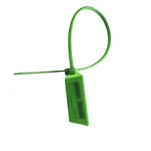
Our RFID truck seals combine a compact ABS electronic housing, replaceable steel cable and UHF identification for dispatch, route handover and receiving checks. The seal identity can be linked with a specific truck, trailer, driver assignment or cargo record.
RFID Truck Seal Specifications
Match the RFID configuration, cable arrangement and reader infrastructure with the vehicle type and transport workflow.
| Specification | Available Configuration | Truck Project Requirement |
|---|---|---|
| Tag dimensions | 118 × 33 × 15 mm | Check clearance around the door and locking bars. |
| Chip | G2IL+ | Confirm compatibility with the fleet reader system. |
| RFID protocol | ISO 18000-6C Gen2 | Use a compatible UHF reader configuration. |
| TID or UID | 64 bits | Define its relationship with the issued seal. |
| EPC memory | 128 bits | Provide the required vehicle or shipment code. |
| User memory | 0 bits | Keep trip details in the fleet database. |
| Reserved memory | 32-bit access and 32-bit kill passwords | Set authorized password-management rules. |
| Operating frequency | 860–960 MHz | Select the frequency allowed on the route. |
| Reference read range | Up to 6 m on metal, reader dependent | Validate the truck lane before deployment. |
| Housing | ABS plastic | Confirm transport exposure and handling conditions. |
| Cable | Replaceable steel cable | Specify length for the selected vehicle closure. |
| Installation | Hanging style | Confirm the sealing and inspection position. |
| Characteristics | On-metal use and detection sensor | Define the required seal-status response. |
Connect Each Seal with a Truck Movement
The operating system should preserve the relationship between the seal identity, secured vehicle opening and authorized journey.
Issue the Seal
Assign the EPC and housing identity to the truck, trailer, route and shipment record.
Secure the Door
Route the specified cable through the approved locking point and complete the dispatch check.
Verify Handover
Read the seal when custody passes between the shipper, driver, depot or receiving operator.
Close the Trip
Reconcile the arriving identity and inspection result before unloading is authorized.
Truck and Trailer Installation Positions
Select a protected opening that allows secure cable routing and repeatable RFID presentation at each checkpoint.
Box Truck Rear Doors
Route the cable through the approved hasp or locking hardware without interfering with normal door operation.
Semi-Trailer Doors
Position the housing consistently near the locking bars for predictable roadside and gate inspection.
Refrigerated Vehicles
Check the door hardware, insulation construction and operating environment before confirming placement.
Tanker Compartments
Confirm cable dimensions and attachment geometry for the selected hatch, valve or protected access point.
Curtainside Trailers
Identify a rigid sealing point that supports inspection without exposing the housing to avoidable impact.
Truck-Mounted Cargo Boxes
Use the seal on service bodies or secured compartments where trip-specific access control is required.
Define Dispatch and Arrival Decisions
| Vehicle Event | Required Comparison | Release Decision | Recorded Evidence |
|---|---|---|---|
| Dispatch loading complete | Seal, truck and shipment records match | Authorize departure under the assigned route | Identity, operator, location and time |
| Depot handover | Arriving identity matches the dispatch record | Accept custody or start an inspection | Handover parties and inspection result |
| Unscheduled stop check | Vehicle and seal remain assigned to the trip | Continue or escalate under fleet procedure | Checkpoint and authorized action |
| Receiving arrival | Seal identity and available status are expected | Authorize unloading or isolate the vehicle | Arrival read and receiving approval |
| Identity mismatch | Captured tag differs from the trip record | Hold access until reconciliation is complete | Both identities and corrective action |
Configure the Vehicle Reading Zone
Gate Reader
- ISO 18000-6C Gen2 compatibility
- Regional UHF frequency support
- Vehicle-speed requirement
- Software event interface
Antenna Layout
- Seal height on each truck type
- Vehicle direction and lane width
- Rear-door housing orientation
- Nearby metal structures
Read Filtering
- Target lane boundaries
- Adjacent vehicle exclusion
- Duplicate event filtering
- Expected dwell time
Route Validation
- Loaded and empty vehicles
- Different trailer constructions
- Wet and dry conditions
- Fixed and handheld backup reads
Prepare the Seal for the Next Vehicle
Manage housing inspection, cable replacement and electronic reassignment as separate controlled tasks.
| Preparation Stage | Physical Task | RFID Task | Approval Result |
|---|---|---|---|
| Trip closure | Remove the seal under authorization | Close the completed vehicle assignment | Housing returned for inspection |
| Housing inspection | Check casing and cable interfaces | Confirm identity and readable response | Accept, repair or retire |
| Cable replacement | Install the specified replacement cable | Retain the controlled housing identity | Prepared for assignment |
| Vehicle assignment | Verify fit at the sealing point | Link the seal to the next trip | Released to the dispatch operator |
Encoding and Fleet-System Integration
Electronic Identity
- 128-bit EPC encoding
- 64-bit TID or UID capture
- Sequential data assignment
- Encoding verification
Fleet Record
- Truck and trailer identifiers
- Driver or carrier assignment
- Route and shipment number
- Dispatch and arrival events
Visible Identification
- Company logo and text
- Human-readable serial number
- Barcode or QR code
- Required housing color
Information Needed for Truck Seal Selection
Vehicle and Route Details
- Truck and trailer types
- Door or compartment locking point
- Required cable length
- Domestic or cross-border route
- Vehicle speed at each checkpoint
- Operating and storage conditions
RFID and Workflow Details
- Destination-country frequency band
- Fixed and handheld reader models
- Required gate reading zone
- EPC and printed-data format
- Seal-status handling rules
- Artwork, quantity and destination
Related Transport Security Seals
Compare cable construction, housing size, seal-state functions and reading requirements for your vehicle fleet.
RFID Truck Seal Questions
Which truck doors can use this RFID seal? +
The seal can be evaluated for rear doors, trailer closures, cargo compartments and other openings that accept the specified steel cable. Confirm the locking-point dimensions and required cable route.
Can the steel cable be replaced? +
Yes. The listed design uses a replaceable steel cable. The electronic housing should be inspected and approved before it is linked with another vehicle movement.
Can a gate reader identify the seal automatically? +
A compatible fixed UHF system can capture the seal when the vehicle passes through a validated reading zone. Antenna position, lane width, vehicle speed and software filtering must be configured for the site.
Is the six-meter reading distance guaranteed? +
No. Six meters is a reference maximum. Reader power, antenna gain, seal orientation, vehicle construction, interference and regional regulations determine the actual distance.
Does the seal track a truck throughout its route? +
The passive UHF seal creates events when it is read by compatible equipment. Continuous location tracking requires separate telematics or GPS equipment and a connected fleet-management platform.
Can trip information be stored in the chip? +
The listed configuration has a 128-bit EPC and no user memory. Store detailed vehicle, driver, route and cargo information in the connected database and use the EPC as its reference.
What information is needed for a quotation? +
Please provide the vehicle type, sealing point, cable length, operating route, destination country, reader models, required read zone, EPC format, status workflow, artwork and quantity.
Configure RFID Seals for Your Truck Fleet
Send us your truck types, sealing positions, cable requirements, operating routes, reader setup, encoding format, status workflow, artwork and quantity for configuration review and pricing.
Request an RFID Truck Seal ReviewHot Tags: rfid truck seals, China rfid truck seals manufacturers, suppliers, factory, Padlock Security Seals, rfid seal for bakery products, rfid seal for decoders, rfid seal for equipment, rfid seal for package, rfid tracking seal