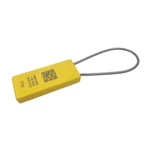
Our wire security seals tag combines a compact 118 × 33 × 15 mm ABS housing, replaceable steel cable, G2IL+ UHF chip and detection sensor. It is intended for RFID identification and seal-status inspection on metal containers, equipment and controlled assets.
Wire Security Seals Tag Specifications
This compact hanging-style model differs from longer one-piece wire seals by allowing the cable and RFID housing to be configured around the protected closure.
| Specification | Listed Configuration | Project Requirement |
|---|---|---|
| Tag dimensions | 118 × 33 × 15 mm | Check the available mounting and inspection area. |
| RFID chip | G2IL+ | Confirm EPC structure and reader compatibility. |
| Protocol | ISO 18000-6C Gen2 | Use compatible UHF readers and middleware. |
| Operating frequency | 860–960 MHz | Specify every country where the seal will be read. |
| TID/UID | 64 bits | Define whether TID will be captured during issue. |
| EPC memory | 128 bits | Provide the electronic seal-number format. |
| User memory | 0 bits | Store shipment and inspection data in the backend. |
| Reserved memory | 32-bit access and 32-bit kill passwords | Define password generation and ownership. |
| Housing | ABS plastic | Confirm handling and environmental conditions. |
| Cable | Replaceable steel cable | Provide the required length, diameter and wire route. |
| Reference read range | Up to 6 m on metal | Test with the intended reader and installation. |
| Installation | Hanging style | Confirm how the tag and cable attach to the closure. |
| Application feature | On-metal use with detection sensor | Define the status-reading and exception workflow. |
Separate the RFID Housing from the Cable Route
The replaceable cable construction lets buyers select a wire path for the closure while positioning the RFID housing where it can be inspected and read.
Measure the Closure
Record the diameter of each hole and the total distance around the protected parts.
Select the Cable
Match cable length and diameter to the opening, required flexibility and removal method.
Position the Housing
Keep the 118 × 33 × 15 mm housing visible and correctly oriented for reading.
Verify the Status
Test the sealed and opened conditions with the selected reader and application.
Choose the Cable for the Actual Locking Path
| Selection Area | Information to Provide | Why It Affects the Seal |
|---|---|---|
| Closure-hole diameter | Minimum diameter of every hole in the route | Determines whether the selected cable can pass through. |
| Cable length | Measured route plus the required working allowance | Controls reach, slack and housing position. |
| Cable diameter | Required diameter or available opening dimensions | Affects fit, flexibility and authorized cutting. |
| Movement during use | Vibration, door movement and handling conditions | Helps prevent unwanted tension on the cable and housing. |
| Removal procedure | Authorized tool, operator and opening location | Defines how used cables are controlled and replaced. |
| Reuse policy | Whether the electronic housing will be reassigned | Determines record reset, inspection and replacement rules. |
Applications Requiring a Replaceable Cable
The separate steel cable can support closures where routing dimensions vary or where the RFID housing must remain in a controlled reading position.
Container Hardware
Route the selected cable through compatible container or cargo-door locking points.
Power Equipment
Identify controlled cabinets, meters or access covers with metal surroundings.
Tank and Vehicle Closures
Apply the seal to compatible hatches or secured points after checking the wire route.
Cash and Document Boxes
Link a locked container with a digital custody and inspection record.
Warehouse Assets
Identify cages, tools or equipment that require controlled access verification.
Customs Inspection Points
Support RFID identity checks within an approved customs or logistics workflow.
Link the Seal to a Backend Record
The listed chip has no user memory, so the EPC should act as the key to externally stored shipment, asset and inspection information.
Seal Identity
Assign the 128-bit EPC to the housing before it enters the operational inventory.
Asset Assignment
Link the EPC with the container, equipment, shipment or protected access point.
Inspection History
Store reader events, personnel, locations and observed physical condition externally.
Cable Replacement
Record each authorized cable change before reassigning the electronic housing.
Plan the On-Metal Reading Arrangement
| Deployment Factor | Site Check | Acceptance Test |
|---|---|---|
| Metal surface | Identify the material and shape behind the housing. | Read the seal in its final mounted position. |
| Tag orientation | Define the expected angle between tag and reader antenna. | Test every normal approach direction. |
| Reader type | Record the handheld or fixed-reader model. | Use the intended power and antenna settings. |
| Reading distance | Set the minimum required operational range. | Confirm reliable reads rather than a single maximum read. |
| Nearby RFID tags | Estimate tag quantity inside the reading zone. | Confirm that the correct seal can be identified. |
| Regional frequency | List every destination and operating country. | Verify the selected tag and reader configuration. |
Define How Each Seal Condition Is Handled
| Observed Condition | Digital or Physical Check | Operational Response |
|---|---|---|
| Expected sealed condition | EPC, cable and housing match the assigned record. | Record the inspection and continue the process. |
| Unexpected EPC | The scanned identifier differs from the expected seal. | Hold the item for identity verification. |
| Cut or replaced cable | Cable condition differs from the last approved record. | Check whether replacement was authorized and documented. |
| Changed sensor state | The reader or software reports an unexpected condition. | Inspect the closure and review handling records. |
| Unreadable tag | The EPC cannot be obtained at the approved position. | Repeat the read and perform a visual inspection. |
| Authorized reassignment | The housing is approved for another asset or closure. | Close the previous record before creating a new assignment. |
Encoding and Identification Options
EPC Configuration
- Customer-defined EPC structure
- Sequential seal identifiers
- EPC readback verification
- Electronic mapping file
Visible Identification
- Human-readable seal number
- Barcode or QR code
- Company name or logo
- Variable asset information
Cable Configuration
- Required steel-cable length
- Compatible cable diameter
- Replacement-cable packaging
- Application-specific routing
Information Needed for Configuration
Application Details
- Protected container, equipment or asset
- Closure photographs and hole dimensions
- Required cable length and diameter
- Housing position and nearby metal
- Operating and storage environment
RFID and Order Details
- Destination country and frequency region
- Reader, antenna and software models
- EPC format and status workflow
- Printing and variable-data requirements
- Quantity and delivery destination
Related RFID Security Seals
Compare housing size, cable construction, reuse procedure, sensor behavior and reading distance before selecting another RFID seal.
Wire Security Seals Tag Questions
What is included in the 118 × 33 × 15 mm size? +
The listed dimensions describe the tag housing. The replaceable steel cable should be specified separately according to the closure holes, required route and working allowance.
Can the steel cable be replaced and the housing reused? +
The product uses a replaceable steel cable. Reusing the electronic housing requires an approved inspection, record-closing and reassignment procedure so the new cable and asset remain traceable.
Can this tag store shipment details in user memory? +
No user memory is listed for the G2IL+ configuration. Store shipment, asset, operator and inspection details in the backend and retrieve them through the EPC or associated TID.
Is the 6 m on-metal reading range guaranteed? +
No. Up to 6 m is a reference result. Reader power, antenna gain, metal geometry, installation orientation, interference and regional limits affect the actual distance.
Can the tag be mounted directly near metal equipment? +
The listed construction is intended for on-metal use. Final performance should still be tested on the actual container, cabinet, vehicle or equipment because metal shape and orientation affect UHF behavior.
Does the detection sensor send alerts by itself? +
The passive tag does not independently transmit a continuous remote alert. A compatible UHF reader, software and backend rule are required to obtain and process the seal condition.
Will the tag work throughout the full 860–960 MHz band? +
The product family covers common UHF regions, but the supplied configuration and reader settings should be selected for the intended country. Provide all operating markets before ordering.
What information is required for a quotation? +
Please provide closure photographs, hole dimensions, cable length and diameter, housing position, destination country, reader model, EPC format, status workflow, printing, quantity and delivery destination.
Match the RFID Housing and Cable to Your Closure
Send us the closure photographs, wire-path dimensions, cable requirement, installation position, operating region, reader setup, EPC format and quantity for configuration review and pricing.
Request a Wire Seal Tag ReviewHot Tags: wire security seals tag, China wire security seals tag manufacturers, suppliers, factory, rfid seal for bakery products, rfid seal for conveyor belts, rfid seal for drawers, rfid seal for file, rfid seal for hvac systems, rfid seal for microprocessors