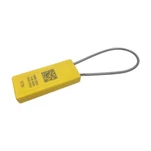
Our RFID seals for container tag combines a single-use locking structure, ABS body, galvanized steel cable and electronic identification. It supports contactless verification of the seal assigned to a container while retaining visible evidence after forced opening or cable removal.
RFID Container Seal Configuration
Confirm the ordered chip, frequency, memory, cable and reader requirements against the final product datasheet before approving a production configuration.
| Configuration Area | Available Product Direction | Information Required |
|---|---|---|
| Product type | RFID wire seal for container closures | Container type and locking-point photographs |
| Seal lifecycle | Single locking cycle | Issue, locking, opening and disposal process |
| Housing | ABS plastic body | Outdoor, impact and handling conditions |
| Cable | Galvanized steel cable | Diameter, length and complete wire route |
| RFID technology | Contactless UHF identification | Chip, protocol and frequency specification |
| Memory | EPC and chip-dependent memory areas | EPC length, user data and password needs |
| Reading distance | Multi-meter reading, configuration dependent | Reader, antenna, distance and vehicle speed |
| Tamper evidence | Physical evidence after forced opening | Required inspection and exception procedure |
| Visible identification | Serial, barcode, QR code, logo or text | Artwork and variable-data file |
| RFID encoding | Customer-defined EPC and data matching | Encoding rules and output-file format |
Check Container-Door Compatibility
The cable must pass through the selected container hardware while the RFID body remains clear of crushing, sharp bending and door movement.
Locking-Rod Bracket
Measure the available holes and cable route with both container doors fully closed and aligned.
Door-Handle Retainer
Check whether the selected cable passes through the retainer without restricting normal handle operation.
Custom Security Fitting
Provide a drawing when the container uses an added bracket, guard or protected sealing box.
RFID Body Clearance
Keep the tag body away from hinges, door edges, lifting equipment and direct impact points.
Metal Orientation
Approve one repeatable installation position because container steel affects the UHF reading zone.
Removal Access
Allow safe access for the approved cutting tool without damaging the container hardware.
Create the Seal-to-Container Record
Issue
Capture the RFID identity, visible serial and production batch before assignment.
Assign
Link the seal with the container, shipment, booking, vehicle and route.
Lock
Install the cable and record the final RFID and visible inspection results.
Release
Permit dispatch only after the physical seal and digital assignment match.
Container Arrival Acceptance
At destination, electronic identification and physical inspection should be completed before cable removal or unloading.
| Arrival Check | Expected Evidence | Decision | Record to Retain |
|---|---|---|---|
| Container identity | Container number matches the inbound record | Continue to seal verification | Container and booking number |
| RFID seal identity | EPC or chip identity matches dispatch | Continue if no mismatch exists | Reader, time and location |
| Visible serial number | Printed number matches the RFID relationship | Investigate any substitution | Serial and inspection image |
| Cable condition | No unexplained cut, splice or replacement | Hold visible exceptions | Cable and lock photographs |
| Seal body | No unexplained damage or alteration | Apply the inspection procedure | Observed condition |
| Opening authority | Named receiver and release approval | Permit controlled removal | Operator and opening time |
Manage Common Arrival Results
Release Through the Approved Process
The container, RFID identity, printed serial and physical seal condition match the dispatch record.
Check for Assignment or Seal Substitution
Compare the RFID value, visible number, shipment file and loading-site evidence before release.
Use a Controlled Secondary Inspection
Reposition the reader, inspect the housing and use the visible serial to locate the assigned record.
Hold the Container for Review
Photograph the cable, locking point and tag body before any authorized removal occurs.
Reconcile the Replacement Seal
Confirm the inspection record and match the replacement seal used for the remaining route.
Resolve the Transport Record
Do not rely on a valid seal identity when the associated container or shipment is incorrect.
Plan UHF Reader Deployment
The final reading distance depends on the ordered tag configuration, reader antennas, container metal, installation orientation and operating environment.
| Reading Point | Primary Purpose | Site Input | Field Test |
|---|---|---|---|
| Seal issue desk | Encoding and identity verification | Desktop reader and data software | Write and read back every ordered field |
| Loading bay | Container and seal assignment | Door position and nearby equipment | Read the seal after installation |
| Vehicle gate | Automatic arrival or departure record | Lane width, speed and antenna layout | Use loaded vehicles at operating speed |
| Container yard | Controlled inventory verification | Stacking pattern and metal reflections | Test every required container position |
| Inspection station | Individual exception review | Handheld reader and close access | Select the intended seal among nearby tags |
Printing, Serialization and Encoding
We can coordinate visible identification and RFID data after the chip, memory and numbering requirements are confirmed.
Visible Seal Data
- Sequential seal number
- Barcode or QR code
- Company logo and text
- Container or route identifier
- Color-coded seal groups
RFID Data
- Customer-defined EPC
- Chip identity collection
- User-memory encoding if supported
- Access-password configuration
- Read-back verification
Matching Records
- RFID-to-visible-number relationship
- Duplicate-identifier checking
- Production batch information
- Sequential issue order
- Finished data output file
Qualification Before Volume Ordering
Mechanical Qualification
- Cable fit through actual door hardware
- Locking action and pull direction
- RFID body clearance
- Controlled cutting procedure
- Visible evidence after opening
RFID Qualification
- Chip and protocol compatibility
- Regional UHF frequency
- Installed reading distance
- EPC and printed-code matching
- Gate and handheld reader performance
Information Needed for Configuration
Container Hardware
- Container and door type
- Locking-point photographs
- Hole and wire-path dimensions
- Required cable length and diameter
RFID System
- Required chip and protocol
- Deployment country and frequency
- Reader and antenna models
- Required operating distance
Order Data
- Artwork and serial-number rules
- Barcode or QR-code format
- EPC and memory requirements
- Quantity and delivery schedule
Related RFID Container Seals
Compare the locking structure, cable dimensions, chip, frequency, read range and electronic detection requirements before selecting another seal.
RFID Container Seal Tag Questions
Does this RFID seal fit every shipping container? +
No universal fit should be assumed. The cable must pass through the selected locking hardware, and the RFID body needs sufficient clearance from door movement and crushing points.
Can the container seal be reused after opening? +
The seal is intended for one locking cycle. After cable removal or forced opening, record the event and apply a newly serialized seal if secured custody continues.
What chip and operating frequency should be ordered? +
Confirm the chip, protocol and regional UHF band from the final ordered-version datasheet. Selection depends on the deployment country, reader infrastructure, memory and data requirements.
What reading distance can the seal provide? +
The achievable distance depends on the selected chip and antenna, reader power, antenna gain, seal orientation, container metal, interference and vehicle speed. Approve it through an applied gate test.
Can this wire seal replace a high-security bolt seal? +
Do not substitute a wire-style RFID seal where a regulation, authority or contract requires a certified high-security bolt seal unless the responsible party explicitly approves the alternative.
Can the printed number match the encoded EPC? +
Yes. We can review the EPC format, visible serial, barcode or QR code, variable-data file and required matching output before production.
What information is required for a quotation? +
Please provide the container-door photographs, cable dimensions, deployment countries, chip and memory requirements, reader models, reading distance, artwork, encoding rules, quantity and delivery schedule.
Match the RFID Seal to Your Container Hardware
Send us the container-door photographs, cable dimensions, operating region, reader setup, chip and memory requirements, artwork, encoding rules and quantity for review.
Request a Container Seal Tag ReviewHot Tags: rfid seals for container tag, China rfid seals for container tag manufacturers, suppliers, factory, rfid seal for carts, rfid seal for content management software, rfid seal for demultiplexers, rfid seal for packing machines, rfid seal for textile, rfid seal for tools