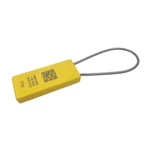
Our e-seal RFID tag combines a 3.5 mm galvanized wire with an ETSI-band UHF identity for meters, valves, storage interfaces and other controlled access points. It allows inspection teams to associate each installed seal with a specific device, location and authorized work order.
Operational focusOne electronic seal identity, consistent inspection fields and controlled permissions across multiple facilities.
E-Seal RFID Tag Specifications
Match the steel wire, RFID memory, European frequency and hanging installation with the protected industrial access point.
| Specification | Listed Configuration | Industrial Project Input |
|---|---|---|
| Wire diameter | 3.5 mm galvanized steel wire | Equipment sealing-hole dimensions |
| Tag dimensions | 300 × 59 × 20 mm | Clearance around the access point |
| Copper antenna | 48 × 26.9 mm | Reader-facing housing position |
| Chip | KX2005X-BL | Reader and software support |
| Protocol | ISO 18000-6C Gen2 | Compatible UHF infrastructure |
| TID or UID | 96 bits; customizable to 192 bits | Chip-identity requirement |
| EPC memory | 96 bits; extendable to 240 bits | Equipment-seal coding format |
| User memory | 1312 bits | Approved inspection data fields |
| Reserved memory | 64 bits | Required access controls |
| Operating frequency | 865–868 MHz | Countries and reader regions |
| Reference read range | Up to 5 m in free air or near metal | Inspection position and reader model |
| Construction | ABS housing and galvanized steel wire | Site and exposure conditions |
| Installation | Hanging style | Installation and removal procedure |
Industrial Access Points for RFID Sealing
Electricity Meters
Associate the installed seal with the meter, service location and authorized maintenance record.
Water Meters
Use the wire seal on compatible covers or adjustment points that require controlled access.
Oil and Gas Valves
Link a secured valve position with the facility, asset and inspection procedure.
Storage Interfaces
Seal compatible filling, discharge or sampling interfaces against unauthorized access.
Industrial Cabinets
Identify sealed control cabinets and document authorized maintenance openings.
High-Value Equipment
Protect suitable panels, covers or service points with a serialized inspection identity.
Standardize Deployment Across Multiple Sites
Define Asset Classes
Group meters, valves, cabinets and interfaces by hardware and inspection method.
Approve Seal Positions
Record the wire route, tag location and reader presentation for each asset class.
Issue Site Rules
Define who may install, inspect, remove and replace each electronic seal.
Audit the Records
Reconcile installed, removed, unused and exception seal identities by location.
Assign Roles and RFID Permissions
| Operating Role | Permitted Task | Required Record | Restricted Action |
|---|---|---|---|
| Seal administrator | Create identifiers and issue stock | Batch, EPC and assigned site | Unrecorded number-range changes |
| Installation technician | Fit the seal to an approved asset | Asset, location, installer and time | Editing protected RFID fields |
| Inspection operator | Read and visually inspect the seal | Identity, result and inspection point | Removing or reassigning the seal |
| Maintenance supervisor | Authorize opening and replacement | Work order and removed-seal identity | Closing records without evidence |
| System auditor | Review histories and exceptions | Audit period and findings | Changing operational events |
Build the Equipment-to-Seal Record
Asset Identity
- Equipment or meter number
- Asset class and model
- Site and installation position
- Responsible department
Seal Identity
- Printed serial number
- Encoded EPC
- Captured TID or UID
- Production batch
Work Record
- Installation work order
- Technician and timestamp
- Inspection history
- Authorized removal reason
Handle Inspection Exceptions Consistently
| Inspection Result | Physical Review | System Review | Required Response |
|---|---|---|---|
| Expected seal | Wire and housing appear consistent | Identity matches the assigned asset | Complete the routine inspection |
| Unknown identity | Compare visible markings | Search issue and transfer records | Hold the asset for investigation |
| Wrong asset match | Check installation location | Compare seal and asset assignments | Escalate a possible reassignment error |
| Unreadable RFID tag | Inspect damage and orientation | Review the last successful event | Use manual identification and replace if authorized |
| Wire or housing exception | Document the observed condition | Check maintenance and access history | Apply the site's investigation procedure |
Validate Fit and Readability on Each Asset Class
Mechanical Fit
- Opening accepts the 3.5 mm wire
- Housing clears nearby components
- Wire route does not obstruct operation
- Removal tool has controlled access
RFID Fit
- Tag orientation is repeatable
- Nearby metal is represented
- Required distance is tested
- Reader commands access required fields
Workflow Fit
- Operators can identify the correct asset
- Inspection fields are practical
- Exceptions reach the responsible team
- Replacement records close correctly
Printing, Encoding and Site Allocation
Visible Data
- Asset or seal serial number
- Company and site code
- Barcode or QR code
- Inspection instruction
RFID Data
- Approved EPC structure
- Optional user-memory values
- TID and EPC relationship
- Read-after-write verification
Site Distribution
- Number ranges by location
- Batch-separated packaging
- Site-specific labels
- Electronic allocation file
Information Needed for Configuration
Asset and Site Requirements
- Meter, valve or equipment type
- Sealing-point dimensions
- Required wire route
- Site environment and nearby metal
- Installation and removal procedure
RFID and Control Requirements
- Countries and reader frequency
- Reader and antenna models
- EPC and user-memory requirements
- Operator roles and inspection fields
- Artwork, quantity and site allocation
Related RFID Security Seal Products
Compare wire diameter, memory capacity, regional frequency and installation method for industrial and logistics sealing projects.
E-Seal RFID Tag Questions
Can this e-seal be used on electricity or water meters? +
It can be evaluated where the meter has a compatible sealing point for the 3.5 mm wire and enough clearance for the 300 × 59 × 20 mm housing. Applied samples should be tested first.
Can the tag be used on petrochemical valves? +
Provide the valve, sealing point, environment and site safety requirements. The buyer must confirm the suitability of the complete applied assembly for the specific facility.
Can different sites use separate EPC ranges? +
Yes. Define the identifier structure, site codes and allocated number ranges before encoding. Packaging and output records can then follow the approved allocation.
Should every operator have RFID write access? +
No. Assign only the permissions required by each role. Routine inspectors may need read access, while encoding or protected updates should remain under controlled authorization.
Does the seal continuously monitor remote industrial sites? +
The passive RFID seal is read when it enters a compatible reader field. Continuous remote monitoring requires separate powered communication equipment and site infrastructure.
Is the five-meter reading distance guaranteed near equipment? +
No. Five meters is a reference maximum. Equipment metal, housing orientation, reader output, antenna placement, interference and regional settings affect the final distance.
What information is required for a quotation? +
Please provide the asset types, sealing-point dimensions, site environment, operating countries, reader models, required distance, EPC structure, user-data fields, site allocation, artwork, quantity and destination.
Configure RFID Seals for Industrial Access Points
Send us your equipment types, sealing points, site conditions, reader setup, permission workflow, encoding fields and quantity for configuration review and pricing.
Request an Industrial E-Seal ReviewHot Tags: e seal rfid tag, China e seal rfid tag manufacturers, suppliers, factory, rfid seal for conveyor belts, rfid seal for drawers, rfid seal for ip cameras, rfid seal for meat, rfid seal for sorting systems, rfid seal for textile