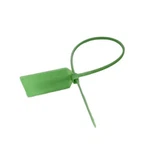
Our RFID seal label combines a G2IL+ UHF chip, adhesive tamper-sensitive structure and 128-bit EPC identity in a 75 × 58 mm format. It is designed for meter covers, access joints and equipment enclosures that require contactless identification together with evidence of attempted label removal.
RFID Seal Label Specifications
The listed 6-meter reading distance is a reference under suitable air conditions. Reader power, antenna position, nearby metal, installation surface and tag orientation determine the achieved result.
| Specification | Listed Configuration | Project Requirement |
|---|---|---|
| Tag dimensions | 75 × 58 × 0.2 mm | Measure the meter cover and protected joint. |
| Antenna dimensions | 71 × 54 mm | Provide a sufficiently flat bonding area. |
| Chip | G2IL+ | Confirm the required tamper and password settings. |
| Protocol | ISO 18000-6C EPC Gen2 | Confirm reader and middleware compatibility. |
| TID / UID | 96 bits | Define how the identifier maps to the meter record. |
| EPC memory | 128 bits | Approve the EPC structure before encoding. |
| User memory | No user-memory allocation listed | Store extended information in the database. |
| Password functions | Access and kill password fields | Confirm bit allocation and access policy. |
| Operating frequency | 902–928 MHz | Confirm the destination-market frequency plan. |
| Reference read range | Up to 6 m in air | Validate the installed meter and reader layout. |
| Material | Dual silicon and transparent PET liner | Approve the material sample and printed finish. |
| Installation | Adhesive backing | Confirm metal, plastic, coating and curvature. |
| Security feature | Tamper-sensitive detection structure | Define the expected response after damage. |
Connect the Seal to a Meter Inspection Workflow
The passive label does not transmit continuously by itself. A handheld or fixed UHF reader must interrogate the label before the system can evaluate the returned identity and condition.
Commission
Encode the approved EPC and associate it with the correct meter, location and customer record.
Apply
Bridge the protected cover or joint using the approved surface preparation and label orientation.
Interrogate
Read the installed seal during commissioning, routine inspection or an exception investigation.
Evaluate
Compare the response with the expected meter record and route abnormal results for inspection.
Apply the Seal to Utility Meter Access Points
Water Meter Cover
Bridge the meter cover and housing where unauthorized opening should disturb the adhesive security label.
Electricity Meter Enclosure
Protect the terminal-cover joint while maintaining a suitable antenna position for field inspection.
Gas Meter Access Point
Seal the approved service joint after reviewing surface material, curvature and operating conditions.
Control Cabinet Door
Place the label across the cabinet access edge when opening evidence and UHF identification are required.
Inspection Port
Protect removable covers or calibration points that should remain closed between authorized services.
Equipment Housing
Use the label on compatible industrial enclosures after applied-surface and RF performance testing.
Structure the EPC Around Meter Operations
| Data Element | Recommended Location | Operational Purpose | Source System |
|---|---|---|---|
| RFID seal EPC | Tag EPC memory | Identify the issued seal | Encoding or commissioning file |
| Chip identifier | Tag TID | Support chip-level record matching | RFID reader output |
| Meter number | Backend database | Connect the seal with one meter | Utility asset register |
| Service location | Backend database | Confirm the assigned installation point | Field-service system |
| Installation event | Backend database | Record date, technician and initial result | Commissioning application |
| Inspection result | Backend database | Record normal or abnormal field status | Handheld or fixed-reader software |
Select the RFID Reading Method
Handheld Inspection
A field technician deliberately reads selected meters and records the result during a service route.
Commissioning Bench
Encode, verify and associate each seal before it is released for field installation.
Fixed Inspection Point
Use controlled reader coverage where tagged equipment passes through a defined service or receiving point.
Exception Verification
Use a known reader position to recheck missing, weak or mismatched responses before investigation.
Define the Response to Each Read Result
| Observed Result | Possible Meaning | Field Check | System Action |
|---|---|---|---|
| Expected EPC responds | Assigned seal is readable | Inspect visible condition and meter number | Record the normal inspection event |
| No EPC response | Damage, shielding, orientation or missing seal | Move closer and inspect the installation | Route unresolved cases for review |
| Unexpected EPC | Wrong seal, wrong meter or nearby tag | Isolate the target and repeat the read | Compare against the assignment record |
| Changed security response | The tamper structure may have been disturbed | Inspect tearing, lifting and access points | Apply the buyer's tamper-event rule |
| Weak or intermittent response | Poor placement, damage or RF interference | Use the approved distance and orientation | Record and investigate repeated failures |
Control Installation on Meter Surfaces
Prepare the Surface
- Remove dust, oil and condensation
- Check paint and plastic compatibility
- Use the approved installation temperature
- Avoid loose or removable surface films
Position the Antenna
- Use the approved label orientation
- Avoid sharp conductive edges
- Keep the antenna area reasonably flat
- Check nearby metal and wiring
Verify the Installation
- Read the seal after application
- Confirm the assigned meter number
- Record the initial reader result
- Inspect adhesion around every edge
Validate the Complete Meter-Seal System
Encode
Write the approved EPC and verify its relationship with the printed serial and meter record.
Install
Apply the label to production-representative metal or plastic meter housings.
Read
Measure performance at the required distance, angle and reader power in the actual environment.
Disturb
Perform controlled removal and damage tests, then verify the physical and reader-observed results.
Information Needed for Configuration
Meter and Installation Details
- Meter type and enclosure photographs
- Metal, plastic and coating materials
- Protected cover or access joint
- Available flat application area
- Outdoor and environmental conditions
RFID and Data Details
- Destination country and UHF band
- Reader, antenna and software models
- Required EPC numbering structure
- Printing and serialization format
- Quantity and packaging requirements
Related RFID Security Labels and Readers
Compare mounting surface, frequency, read distance, security response and data requirements before selecting another RFID seal.
RFID Seal Label Questions
Does the RFID seal send an alarm by itself? +
No. It is a passive UHF label. A compatible reader must interrogate the seal, and the connected software must interpret the returned or missing response.
Is the 6-meter reading distance guaranteed? +
No. It is a reference under suitable conditions. Reader power, antenna gain, orientation, nearby tags, metal and the installed meter structure affect actual range.
Can the seal be applied directly to a metal meter? +
The target page lists suitability for metal and plastic surfaces, but performance must be tested on the actual housing, coating, position and reader configuration.
What data can be encoded in the label? +
The listed configuration provides a 128-bit EPC and no user-memory allocation. Store detailed meter, location and inspection information in the connected database.
Can multiple meter seals be read together? +
UHF EPC Gen2 supports multi-tag reading. Reader coverage, tag spacing and nearby meters must be controlled so the system can distinguish the intended inspection group.
Can EPC data be matched with printed serial numbers? +
Yes. We can review printing, serialization and EPC encoding after the numbering structure, source-data format and required output file are confirmed.
What information is required for a quotation? +
Please provide the meter type, installation surface, protected joint, UHF region, reader model, EPC structure, artwork, quantity and destination country.
Configure the Meter Seal and RFID Workflow
Send us the meter housing, protected joint, installation surface, UHF region, reader model, EPC structure, artwork and quantity for configuration review and pricing.
Request an RFID Seal Label ReviewHot Tags: rfid seal label, China rfid seal label manufacturers, suppliers, factory, rfid seal for box, rfid seal for cement, rfid seal for fire protection systems, rfid seal for landfill, rfid seal for tobacco, Tamper RFID Seal Labels