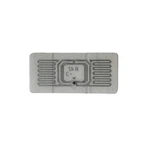
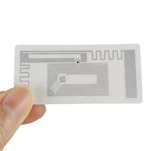
Our NFC tamper-evident tag is a compact 25 × 20 mm adhesive label with an NTAG213 chip, transparent PET face and 17 × 10 mm copper antenna. It is designed for limited application areas where attempted removal should damage the antenna and prevent intact transfer.
NFC Tamper-Evident Tag Specifications
The small rectangular construction leaves limited room for printing and requires accurate positioning. Confirm the finished die line, antenna area and package contact surface before approving artwork.
| Specification | Listed Configuration | Project Confirmation |
|---|---|---|
| Tag dimensions | 25 × 20 × 0.2 mm | Check the available flat application area. |
| Antenna dimensions | 17 × 10 mm copper antenna | Keep critical printing clear of the antenna area. |
| NFC chip | NTAG213 | Confirm the required smartphone or reader workflow. |
| Protocol | NFC ISO 14443A | Test with the devices used by operators or customers. |
| Identifier | 7-byte TID/UID | Define any UID-to-serial-number matching rule. |
| User memory | 144 bytes | Confirm the URL or other encoded content. |
| Operating frequency | 13.0–14.5 MHz | Evaluate the applied tag on the finished item. |
| Nominal read range | Up to 1 cm in an interference-free test | Record the approved device and tap position. |
| Face material | Transparent PET | Approve appearance over the actual surface. |
| Installation | Adhesive backing | Confirm substrate, texture and curvature. |
| Tamper behavior | Antenna damage after removal | Approve the one-time removal result on samples. |
Select This Tag for Limited Application Space
The compact rectangular format is useful where a larger round or long security label would obstruct the product, packaging graphics or access point.
Small Package Seal
Position the tag over a carton flap, container edge or compact closure where opening places stress on the antenna.
Electronic Product
Apply it over a small enclosure seam or access point where an intact transferable identifier is not acceptable.
Certificate or Document
Use the tag where removal from the original paper or document surface should damage its NFC function.
Luxury Item
Attach the low-profile transparent tag to a suitable packaging area without covering more graphics than necessary.
Small size trade-off: The 25 × 20 mm face has limited space for readable logos, QR codes and serial numbers. Simplify the artwork and verify any machine-readable printed code at the final size.
Protect the Copper Antenna During Installation
The antenna must remain intact during converting, printing and application but break when the tag is deliberately removed from the original surface.
Align
Keep the tag flat and position its antenna over the area that should be protected from transfer.
Apply
Use even application pressure without folding, stretching or scraping the compact inlay.
Condition
Allow the adhesive to establish contact under the intended storage and handling conditions.
Remove
Perform a controlled peel test and inspect physical damage, NFC response and transfer resistance.
Check Surface and NFC Compatibility
| Surface | Fit Check | NFC Test | Potential Risk |
|---|---|---|---|
| Coated paper carton | Varnish, lamination and available area | Read before and after conditioning | Weak adhesion to smooth coatings |
| Plastic enclosure | Plastic type, texture and curvature | Check reading at the intended tap point | Edge lift on low-energy plastic |
| Glass container | Cleaning, moisture and temperature | Test the finished filled container | Contamination under the adhesive |
| Paper certificate | Paper strength and surface coating | Verify the encoded record after application | Document damage during sample testing |
| Metal or foil | Conductive material beneath the tag | Measure performance on the final structure | Antenna detuning or no NFC response |
Metal warning: Transparent PET does not make this a direct-on-metal NFC tag. Nearby metal or foil can interfere with the copper antenna, so the complete mounting structure must be tested.
Keep Printing Clear and Scannable
The compact transparent face can support identification graphics, but artwork should be simplified for legibility and verified after converting.
Brand Graphics
- Compact logo or security mark
- Short visible product identifier
- Color selected for the underlying surface
- Clear area around important graphics
Variable Printing
- Short serial or batch number
- QR code sized for reliable scanning
- Barcode subject to available space
- Defined variable-data source file
NFC Encoding
- URL within the available user memory
- Product or package identifier
- UID-to-print matching requirements
- Encoding verification and output data
Authentication scope: The NTAG213 provides an NFC identifier and 144-byte user memory, while the connected website or database determines whether the record is valid and how repeated scans are handled.
Define the One-Time Use Acceptance Result
| Test State | Physical Condition | NFC Response | Acceptance Decision |
|---|---|---|---|
| Before application | Flat tag with an intact antenna | UID and encoded content are readable | Accept for application testing |
| After application | Fully bonded without folds or damage | Tag reads at the approved tap point | Accept as an intact installation |
| After conditioning | No edge lift or premature cracking | Reading remains consistent | Approve for the tested environment |
| After removal | Antenna or face shows irreversible damage | Tag no longer behaves as an intact tag | Confirm one-time anti-transfer behavior |
| No read while intact | No visible removal evidence | Approved device cannot read the tag | Retest and inspect before rejection |
No-read limitation: A failed scan alone does not confirm tampering. Reader position, metallic interference, converting damage and incorrect application can cause a similar result.
Information Needed for a Sample Recommendation
Product and Installation Data
- Application surface and coating
- Available 25 × 20 mm placement area
- Protected opening or access point
- Curvature and expected environment
- Nearby metal or conductive decoration
Digital and Order Data
- NFC reader or phone models
- URL or other encoded content
- Artwork and variable-data format
- Required quantity and destination country
- Expected intact and removed tag behavior
Related Tamper-Evident NFC Tags
Compare tag dimensions, antenna material, face stock, chip protocol and available printing area before selecting another security label.
NFC Tamper-Evident Tag Questions
What makes this tag different from the ISO 15693 sticker? +
This model uses an NTAG213 chip with the ISO 14443A protocol, while the neighboring transparent round sticker uses ISO 15693. Select according to the reader, phone workflow, memory and application size.
Can a smartphone read the NTAG213 tag? +
Compatible NFC-enabled smartphones may read the ISO 14443A tag. Test the intended phone models because settings, package materials, antenna orientation and encoded content affect the result.
Can the tag be reused after it is removed? +
The tamper antenna is designed to become damaged during removal, preventing the label from being transferred as an intact functional NFC tag. Verify this behavior on the actual application surface.
How much information can be stored in the tag? +
The listed NTAG213 configuration provides a 7-byte UID and 144 bytes of user memory. Submit the final URL or data record so its size can be checked before encoding.
Can a QR code be printed clearly on a 25 × 20 mm tag? +
The available printing area is limited by the small finished size and antenna position. Provide the QR data and artwork so the printed code can be sized and tested for reliable scanning.
Can the transparent PET tag be placed directly on metal? +
Direct metal placement can interfere with the copper NFC antenna. Provide the mounting structure and intended position so a suitable construction can be evaluated with the final reader.
What should we provide when requesting samples? +
Please provide the application surface, available area, protected access point, phone or reader model, artwork, encoded content, required quantity, destination country and expected removal result.
Check the Compact NFC Tag Against Your Product
Send us your application area, surface material, protected access point, phone or reader model, artwork, encoded content and quantity for sample evaluation and pricing.
Request a Compact Tag EvaluationHot Tags: nfc tamper evident tags, China nfc tamper evident tags manufacturers, suppliers, factory, anti tampering rfid compatibility, anti tampering rfid durability, rfid protection installation, rfid security installation, rfid security market, tamper proof rfid lifespan