


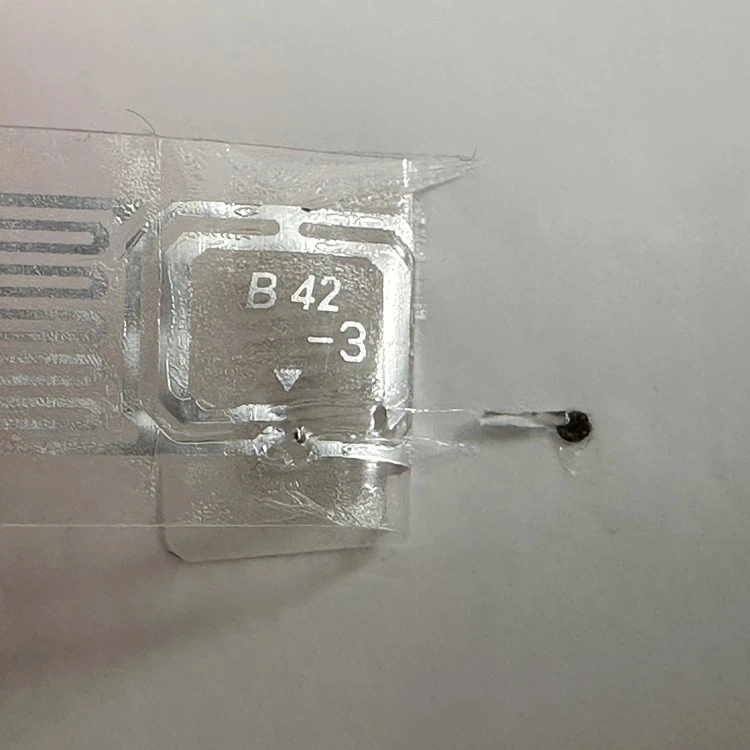
Miniature Anti-Tamper RFID Inlay for Restricted Spaces
Our anti-tamper RFID label uses an M4QT chip and a compact 22 × 8 mm aluminum antenna within a 26 × 12 × 0.2 mm adhesive construction. It is intended for small non-metal items where label-transfer resistance and controlled short-range UHF identification are more important than long-distance reading.
The published construction has no facestock. Buyers requiring printed branding, barcodes or visible serial numbers should specify the required converted label structure rather than assume the bare inlay can serve as the final printed label.
26 × 12 mm Finished inlay dimensions
22 × 8 mm Aluminum antenna size
M4QT ISO 18000-6C Gen2 chip
Up to 10 cm Published free-air range
The compact antenna and short published range make this model a close-range security inlay. It should not be selected for gate access, long-range vehicle identification or distant warehouse portals.
Anti-Tamper RFID Label Specifications
| Specification | Published Configuration | Procurement Check |
|---|---|---|
| Inlay dimensions | 26 × 12 × 0.2 mm | Measure the flat bonding area on the actual item. |
| Antenna dimensions | 22 × 8 mm aluminum antenna | Keep the antenna clear of folds, edges and metal. |
| Chip | M4QT | Confirm the required EPC and user-memory workflow. |
| Protocol | ISO 18000-6C Gen2 | Verify compatibility with the selected UHF reader. |
| Published memory | 96-bit TID/UID, 128-bit EPC/block, 512-bit user memory, 32-bit access and 32-bit kill | Define encoding length, passwords and locking requirements. |
| Operating frequency | 920.5–924.5 MHz | Confirm suitability for the destination market. |
| Facestock | No facestock | Specify any required printable or protective conversion layer. |
| Free-air reading range | Up to 10 cm, reader dependent | Measure installed range on the final item. |
| Installation | Adhesive | Test adhesion and removal response on the real substrate. |
| Published colour | White or customized | Confirm whether this refers to a converted finished label. |
| Characteristic | Tamper-proof | Approve the required failure pattern through samples. |
Choose This Model for Size and Read-Zone Control
Compact Product Areas
The 26 × 12 mm format can be evaluated for small packages, compact components and restricted bonding areas that cannot accommodate longer UHF labels.
Controlled Close Reading
The reading range of up to 10 cm suits checkpoints where the operator intentionally brings a reader near the item. It can also help limit unintended reads beyond the inspection area.
Transfer-Resistant Identity
The tamper-proof structure is intended to damage the antenna or circuit during removal, making the RFID identity difficult to transfer intact to another item.
Short range does not create cryptographic authentication by itself. The EPC or TID must still be checked against an authorized product, component or asset database.
Bare Inlay or Finished Printed Label?
| Requirement | Bare Inlay Consideration | Finished Label Requirement | Information to Confirm |
|---|---|---|---|
| RFID identification only | The published no-facestock construction may be suitable for integration. | An additional face layer may not be necessary. | Application method and protection provided by the product assembly |
| Printed serial number | The inlay is not published with a printable face. | A compatible printable facestock is required. | Font size, number sequence and print contrast |
| Barcode or logo | Artwork space is limited by the compact dimensions. | A converted label may provide the required print surface. | Artwork, barcode type and final label dimensions |
| Surface protection | The antenna may require protection in the final assembly. | A cover layer must preserve the intended tamper response. | Abrasion, moisture and handling conditions |
| Tamper evidence | Circuit failure must be tested after removal. | Facestock and adhesive must not prevent the intended damage. | Required visible and electronic removal result |
Check the Mounting Surface Before Sampling
Non-Metal Surfaces
Evaluate the label on the actual plastic, coated paper, glass or other non-metal substrate. Surface energy, texture, coatings and contamination influence both bonding and removal behaviour.
Metal and Electronics
This model is not published as an on-metal tag. Direct metal contact, batteries, shielding and nearby electronic components can detune the antenna. Review our UHF anti-metal tags when metal mounting is required.
Liquids and Dense Contents
Product contents can change UHF performance even when the outer package is non-metal. Test filled packages in the final label position instead of relying only on empty packaging.
Define the Required Tamper Result
Electronic Failure
The intended security response is damage to the internal antenna or circuit during attempted removal. Buyers should verify whether the tag remains readable after lifting one edge, peeling half of the inlay and removing it completely.
- Read the intact sample first.
- Record the initial installed range.
- Repeat the read after each removal stage.
- Check whether transfer to another item is possible.
Visible Evidence
If visible evidence is required in addition to electronic failure, state that requirement during conversion review.
- Required residue or surface mark
- Expected face-material damage
- Colour or warning-message requirement
- Acceptable post-removal appearance
Encoding and Data-Control Requirements
| Data Item | Published Resource | Buyer Decision |
|---|---|---|
| TID/UID | 96 bits | Decide whether the system records TID alongside EPC. |
| EPC/block | 128 bits | Provide the numbering length, prefix and sequence. |
| User memory | 512 bits | Define the exact fields and encoding format. |
| Access password | 32 bits | Specify the password-generation and handling rule. |
| Kill password | 32 bits | Confirm whether kill functionality will be provisioned. |
| Database relationship | External system required | Define valid, transferred, removed and retired statuses. |
The passive label does not independently report when it is removed. A reader must interrogate the tag, and the connected application must interpret a missing or invalid response according to the project workflow.
Sample Validation Sequence
Confirm the Construction
Decide whether the project needs the bare inlay or a converted label with a printable face.
Apply to Real Items
Use the actual mounting surface, product contents and intended label location.
Measure the Read Zone
Record the installed range and unwanted reads with the final reader and antenna.
Test Attempted Transfer
Read the tag after partial lifting, full removal and attempted reapplication.
Information Needed for a Model Review
Technical Details
- Item dimensions and mounting-surface material
- Nearby metal, battery, liquid or electronics
- Reader model and required read distance
- Destination country and UHF frequency requirement
- Required electronic and visible tamper response
Conversion and Order Details
- Bare inlay or finished-label requirement
- Required quantity and sample quantity
- EPC, user-memory and password instructions
- Printing, barcode or serial-number requirements
- Roll orientation, packaging and destination
Anti-Tamper RFID Label FAQs
Is this a finished printable RFID label? +
The published specification states that the construction has no facestock. If printing, branding, a barcode or a protective face is required, provide the finished-label requirements so we can review an appropriate converted structure.
Why is the reading range only up to 10 cm? +
The inlay uses a compact 22 × 8 mm antenna and is intended for small-item, close-range identification. The actual range also depends on the reader, antenna, mounting surface, item contents and orientation.
Can this label be used for long-range inventory gates? +
This model is not a suitable first choice when metres of reading distance are required. Compare a larger UHF antenna design and test it within the intended portal or inventory read zone.
Does the label automatically alert us when removed? +
No. This is a passive RFID inlay. Its intended response is circuit or antenna damage during removal. Detection requires a reader interrogation and application logic that recognizes a missing or invalid response.
Can it be applied directly to a metal component? +
This model is not specified for direct metal mounting. Metal can severely reduce or eliminate its read performance. Provide the metal structure and available space so an anti-metal option can be evaluated.
What should we inspect during the sample test? +
Check available space, adhesion, installed read distance, unwanted reads, encoded data, partial-removal response, complete-removal response and whether the inlay can be transferred while remaining readable.
Confirm the Inlay Structure and Read Zone
Send us the item size, mounting surface, reader, destination market, required tamper result, encoding data and finished-label requirements.
Hot Tags: anti tamper RFID labels, China anti tamper RFID labels manufacturers, suppliers, factory, anti tamper rfid need, rfid protection performance, rfid security replacement, rfid tamper evident installation, tamper proof rfid use, tamper resistant rfid cost


