Serialized Identification with Transfer Evidence
When Is This Counterfeit Protection Tag Suitable?
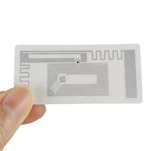
Our RFID counterfeit protection tag combines a transparent PET label, Higgs3 chip and brittle antenna in a narrow 93 × 17 × 0.2 mm self-adhesive format. It is designed for applications that need UHF identification, serialized data and an antenna that becomes unusable after an attempted transfer.
The tag operates at 919–923 MHz and has a published reading range of up to 6 m, depending on the reader and installed environment. Confirm that this frequency range is permitted and compatible with the intended reader system in the destination market.
Protection Architecture
Three Elements Needed for a Working Anti-Counterfeit Process
Serialized RFID Data
Assign each tag an EPC linked to a controlled product or asset record. The Higgs3 chip also provides user memory for project-specific data requirements.
Transfer-Resistant Structure
The brittle antenna is intended to fracture when the attached label is lifted, preventing an intact tag from being transferred to another item.
Controlled Verification
The reader result must be checked against a trusted database. An RFID identifier alone does not establish product authenticity without controlled records and verification rules.
Published Configuration
RFID Counterfeit Protection Tag Specifications
| Specification | Published Value |
|---|---|
| Tag dimensions | 93 × 17 × 0.2 mm |
| RFID chip | Higgs3 |
| TID/UID memory | 96 bits |
| EPC memory | 96 bits |
| User memory | 512 bits |
| Reserved memory | 32 bits |
| Operating frequency | 919–923 MHz UHF |
| Face material | Transparent PET |
| Installation | Self-adhesive backing |
| Listed reading range | Up to 6 m, depending on the reader |
| Security structure | Tamper-proof brittle antenna |
| Standard appearance | Transparent; customization available |
The listed read range is not a guaranteed installed distance. Reader power, antenna position, tag orientation, surface material and nearby metal or liquid can change UHF performance.
Data Planning
Use Each Memory Area for a Defined Purpose
| Memory Area | Typical Project Role | Order Requirement |
|---|---|---|
| TID/UID | Chip-level reference used during tag registration or verification | Define whether the system will capture and store the TID |
| EPC | Primary identifier for UHF inventory and verification workflows | Provide EPC length, numbering sequence and uniqueness rules |
| User memory | Project-specific data when on-tag storage is required | Specify the exact data, format and write-lock requirement |
| Reserved memory | Password-related tag access functions | Confirm password assignment and access-control procedure |
A unique EPC is not sufficient by itself
Effective counterfeit protection requires controlled number generation, secure association between the tag and product record, restricted database access and a clear response for duplicate, missing or damaged tags.
Application Fit
Where the Narrow Transparent Label Can Be Evaluated
Branded Product Packaging
Use serialized RFID records to connect packaging with production, distribution or return data. Confirm that the narrow label fits without covering required graphics.
Electronics and Components
The transparent PET format can reduce visual obstruction. Test RF performance because nearby metal, batteries and electronic assemblies can detune a standard UHF label.
Documents and Certificates
The low-profile adhesive construction can link a physical document to a serialized record. For document-specific structures, compare our RFID document label.
High-Value Goods
Use the tag as one part of a controlled authentication process for watches, cosmetics, jewelry packaging or other serialized goods.
Returns Inspection
Compare the returned EPC with the original sales record and inspect whether the tag or packaging shows evidence of removal.
Vehicle Identification
For windshield or parking access projects, use a tag specifically tuned for glass and the required regional frequency instead of assuming direct interchangeability.
Surface Compatibility
Confirm the Installation Material Before Sampling
| Target Surface | Selection Guidance | Validation Priority |
|---|---|---|
| Paperboard packaging | A practical candidate for initial evaluation | Adhesion, read zone and antenna breakage after lifting |
| Rigid plastic | Test the actual plastic formulation and curvature | Bond strength, surface energy and read consistency |
| Glass | Evaluate at the final mounting position | Frequency, orientation, reader angle and removal response |
| Metal or metal-backed item | A standard transparent label may not perform correctly | Consider a suitable UHF anti-metal tag |
| Curved or textured surface | Confirm available bonding area and bend radius | Edge lifting, antenna stress and adhesive contact |
OEM Preparation
Information Required for Serialization and Printing
Visible Identification
- Logo and approved artwork files
- Serial-number or barcode format
- Variable-data starting number and sequence
- Required print position and readability
RFID Data
- EPC numbering and data-mapping rules
- TID collection requirements
- User-memory content, if required
- Password and memory-lock instructions
We can review transparent appearance, logo printing, serialization, chip encoding and packaging requirements. Send the data specification before production so printed identifiers and RFID records can be checked against one approved mapping rule.
Qualification Sequence
Approve the Tag in Four Controlled Steps
1
Confirm Frequency
Check reader compatibility and local UHF requirements for the destination country.
2
Test the Surface
Measure adhesion and reads on the actual product, package or document.
3
Verify Tamper Response
Attempt removal after application and confirm the expected antenna failure.
4
Approve Data Mapping
Match printed codes, EPC values and database records before mass encoding.
Frequently Asked Questions
RFID Counterfeit Protection Tag FAQ
Can this RFID tag prove that a product is authentic? +
The tag can provide a serialized identifier and transfer evidence, but authentication requires a trusted database, controlled tag assignment and defined verification rules. The tag alone cannot prove authenticity.
What happens if somebody removes the tag? +
The brittle antenna is intended to fracture during lifting or transfer, making the tag unreadable. The result should be verified on the actual surface during sample testing.
Is the 919–923 MHz frequency suitable for every country? +
No. UHF allocations and reader settings vary by market. State the destination country and reader model so frequency compatibility can be confirmed before ordering.
Is the published 6 m reading range guaranteed? +
No. The listed distance depends on the reader. Installed results also vary with antenna placement, power, orientation, frequency, surface material and surrounding objects.
Can the transparent tag be applied directly to metal? +
A standard UHF label can be detuned by metal. Provide the mounting material and required reading distance so an appropriate anti-metal structure can be considered.
Can we match printed serial numbers with EPC data? +
We can review serialized printing and EPC encoding requirements. Provide the numbering logic, data file, field lengths and required output mapping for confirmation.
Can a standard smartphone read this UHF tag? +
Standard smartphones do not normally read UHF EPC tags directly. Use a compatible handheld RFID reader or fixed UHF reader.
What information should we provide for sampling? +
Provide the target surface, destination country, reader setup, required read zone, artwork, EPC format, quantity and packaging requirements.
Related Selection Paths
Compare Security Labels and Reader Options
Define Your Serialization and Verification Rules
Send us the target surface, destination country, reader setup, EPC structure, artwork, required quantity and packaging format. We will review the label configuration for testing and quotation.
Hot Tags: rfid counterfeit protection tag, China rfid counterfeit protection tag manufacturers, suppliers, factory, anti tampering rfid price, rfid anti tamper reliability, rfid protection advantage, rfid tamper evident installation, tamper proof rfid aim, tamper proof rfid item