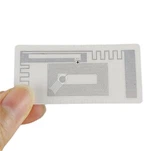
Printable UHF Windshield Credentials for Vehicle Authentication
Our Anti Tamper RFID Windshield Tags provide a printable vehicle credential for compatible UHF access and identification systems. The listed 110 × 40 mm configuration uses an M4QT chip, coated-paper face material and removal-sensitive adhesive construction to discourage transfer between vehicles.
110 × 40 mm Printable coated-paper vehicle-label format.
Up to 10 m Dependent on the reader.
865–868 MHz UHF configuration requiring reader and market matching.
Transfer resistant Tamper-proof construction for vehicle-bound identities.
Anti Tamper RFID Windshield Tag Specifications
The free-air reading value does not define the finished lane result. Windshield composition, mounting position, reader antenna and vehicle movement must be evaluated together.
| Product name | Anti Tamper RFID Windshield Tags |
|---|---|
| Tag dimensions | 110 × 40 × 0.2 mm |
| Antenna dimensions | 100 × 30 mm |
| Chip | M4QT |
| Protocol | ISO 18000-6C Gen2 |
| Memory | 96-bit TID/UID, 128-bit EPC, 512-bit user memory, 32-bit access password and 32-bit kill password |
| Operating frequency | 865–868 MHz |
| Face material | Printable coated paper |
| Listed reading range | Up to 1000 cm in free-air conditions, depending on the RFID reader |
| Installation | Adhesive mounting |
| Security characteristic | Tamper-proof removal response |
Model distinction: This 110 × 40 mm coated-paper, 865–868 MHz configuration is different from our 99 × 24 mm transparent PET windshield tag listed at 920.5–924.5 MHz. Select by reader frequency, printing requirement, windshield position and approved sample result.
Do Not Select a Windshield Tag by Distance Alone
The listed 10-meter value is measured in free-air conditions. A vehicle-access lane adds glass, bodywork, reader-angle, speed and interference variables that can shorten or shift the usable reading zone.
A reliable deployment identifies the target vehicle in the intended lane while avoiding unwanted reads from neighboring lanes, parked vehicles or traffic outside the controlled zone.
Information Needed for Compatibility Review
- Deployment country and permitted UHF frequency
- Reader and antenna models
- Reader output and antenna arrangement
- Lane width and tag-to-antenna distance
- Expected vehicle speed
- Windshield type and mounting position
- Required print, EPC and user-memory data
Vehicle Identification Applications
The tag should be used within a validated UHF reader system. It supplies a vehicle-bound RFID identity but does not independently verify license plates, ownership or vehicle authenticity without supporting records and software.
Parking Access
Identify registered vehicles at controlled entrances and exits without requiring a handheld credential.
Fleet Checkpoints
Connect each authorized vehicle with an EPC identity for dispatching, arrival and movement records.
Vehicle Distribution
Assign an encoded identity during manufacturing or delivery workflows for suitable vehicle traceability tasks.
Controlled Traffic Areas
Recognize authorized vehicles entering campuses, depots, residential areas or restricted facilities.
Build a Lane Test Around Real Operating Conditions
Use representative vehicles and the final reader equipment. Record both successful reads and unwanted reads so antenna power and direction can be adjusted before rollout.
| Test condition | What to vary | What to measure | Approval objective |
|---|---|---|---|
| Stationary vehicle | Tag position and vehicle distance | Read consistency throughout the target zone | Confirm the basic reader-to-tag geometry |
| Moving vehicle | Approach speed and lane position | Successful identification before the control point | Define the permitted operating speed |
| Different windshields | Vehicle model, glass coating and tint | Change in read distance and blind zones | Confirm the supported vehicle range |
| Adjacent traffic | Neighboring lane and vehicle spacing | Unwanted reads outside the intended lane | Reduce cross-lane identification |
| Removal attempt | Peel direction and adhesive dwell time | Visible damage and post-removal readability | Prevent intact credential transfer |
Windshield Installation Checks
- Use clean and dry glass at the approved position.
- Keep the label outside the driver's critical view.
- Check metallic tint, coatings and heating elements.
- Avoid folding, creasing or trapping air under the antenna.
- Use one consistent orientation across the vehicle fleet.
- Allow the agreed adhesive dwell time before removal tests.
Printable Paper Changes Placement Decisions
The listed face material is printable coated paper, not transparent PET. Printing can make the vehicle credential easier to inspect visually, but the label can also obstruct more of the windshield than a transparent construction.
Confirm the permitted mounting area, the required viewing direction and whether the label is intended for an interior glass surface. Any local visibility or windshield-placement requirements remain the buyer's responsibility to verify.
Surface limitation: This configuration is specified as a windshield tag, not an anti-metal label. Do not transfer its free-air reading claim to direct metal installation.
Bind Visible and RFID Vehicle IDs
Custom printing and RFID encoding should be prepared from one controlled data source. The relationship between the visible serial number, barcode or QR code and the EPC must be defined before production.
- Vehicle or permit serial-number structure
- EPC format, length and permitted range
- User-memory data fields
- Access and kill password requirements
- Barcode or QR-code symbology
- Database mapping and import-file format
Customization Information
- Fixed logo, text and color artwork
- Variable vehicle or permit information
- Sequential barcode or QR-code data
- Personalized EPC encoding
- Requested label orientation and roll direction
- Quantity and packaging identification
From Lane Definition to Encoded Production
We recommend approving the installed reading zone, printed credential and tamper result before serialized batch production.
- Step 1 Define the lane Provide distance, speed, lane width and access logic.
- Step 2 Match the hardware Confirm frequency, reader, antenna and windshield type.
- Step 3 Prepare identity data Approve artwork, EPC structure and visible-code mapping.
- Step 4 Test samples Verify attachment, moving reads and removal response.
- Step 5 Release production Confirm encoded data, inspection and packaging references.
Anti Tamper RFID Windshield Tag FAQs
Is the listed 10-meter reading distance guaranteed? +
No. Up to 1000 cm is the listed free-air result and depends on the reader. Windshield composition, tag position, antenna geometry, reader power, vehicle speed and interference determine the installed range.
How is this tag different from the 99 × 24 mm RFID Windshield Tag? +
This model is listed at 110 × 40 mm with printable coated paper, 865–868 MHz operation and up to 10 m free-air reading. The other model uses transparent PET, measures 99 × 24 mm and is listed at 920.5–924.5 MHz with up to 5 m reading.
Will it work through every type of windshield? +
No universal result should be assumed. Metallic tint, heat-reflective coatings, embedded wires and different glass constructions can reduce or block UHF performance. Test representative vehicle models.
Where should the tag be installed? +
Use the position approved during the vehicle test. It should support reliable reading, avoid metallic windshield features and remain outside the driver's critical field of view. Confirm whether interior-glass installation is required.
What happens if the tag is moved to another vehicle? +
The tamper-proof construction is intended to discourage removal and intact transfer. Test samples after the agreed adhesive dwell time to verify visible damage and RFID readability after removal.
Is 865–868 MHz suitable for our country? +
Frequency regulations and reader settings vary by market. Provide the destination country and reader model so the listed 865–868 MHz configuration can be checked against the intended system.
Can you print and encode unique vehicle credentials? +
We can review personalized barcodes, QR codes, text, logos and RFID encoding. Provide the visible-data file, EPC structure, user-memory requirements and mapping rules before proofing.
What information is required for a sample and quotation? +
Provide the destination country, reader and antenna models, lane geometry, vehicle speed, windshield types, mounting position, printing and encoding requirements, quantity and packaging needs.
Validate the Tag in Your Vehicle Access Lane
Send us your reader and antenna models, frequency market, lane distance, vehicle speed, windshield types, mounting position, quantity and encoding requirements. We will review the information needed for sample testing and quotation.
Request Windshield Tag Samples & QuoteHot Tags: anti tamper rfid windshield tags, China anti tamper rfid windshield tags manufacturers, suppliers, factory, rfid protection advantage, rfid security demand, rfid security replacement, tamper proof rfid item, tamper resistant rfid sector, tamper resistant rfid standard