In RFID project selection, Active RFID and Passive RFID are often compared side-by-side. However, the real difference isn't just about whether or not they have batteries, but rather how the tags obtain power, how they communicate with the reader, and the required identification distance and data acquisition frequency. For general goods, logistics packaging, clothing, asset and warehouse inventory management, Passive RFID is usually sufficient; while in scenarios such as large-scale asset location, personnel location, and vehicle management, the advantages of Active RFID become more apparent.
Passive RFID: Powered by the Reader
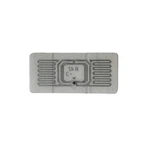
Passive RFID, also known as passive RFID, is a widely used RFID technology in supply chains, retail, and manufacturing. The tag itself typically consists of a chip, antenna, and substrate, without a battery. When the tag enters the reader's radio frequency field, the antenna obtains energy from the electromagnetic field, activating the chip, which then returns the data to the reader via backscatter.
The direct advantages of this working method are a relatively simple tag structure, ease of miniaturization, and no battery life limitations. For RFID tags that are disposable or need to be permanently attached to products, such as clothing tags, carton tags, pallet tags, asset tags, and RFID logistics tags, passive solutions are generally easier to control overall system costs.
However, passive RFID also has an easily overlooked drawback: the tag itself cannot continuously and actively broadcast information like a wireless sensor. It typically needs to enter the effective coverage area of the reader to complete communication. Therefore, the actual reading distance is affected by various factors such as frequency band, tag antenna, reader power, installation method, and the relationship between the tag and metal or liquid.
Active RFID: Tags Have Their Own Power
The core feature of active RFID is that the tag has an independent power source, typically battery-powered. Because the tag does not rely on the reader for operating power, it can use stronger wireless communication capabilities and actively send data or status information according to a set period.
This makes active RFID more suitable for large assets and applications requiring continuous monitoring. For example, in large warehouses, industrial parks, mines, hospitals, or railway facilities, if the number of target objects is small but the value of each asset is high, and long-distance identification or even real-time positioning is required, then using active tags may be more reasonable than deploying a large number of fixed read/write points for each target.
Of course, battery life is also a key consideration for Active RFID systems. Tags require battery life management, and system design must consider transmission power, communication cycle, ambient temperature, and battery replacement or maintenance costs. Therefore, active RFID is not necessarily "higher performance is always better," but rather a trade-off based on specific application requirements.
An engineering approach to judgment
If the requirement is "to read hundreds or thousands of goods or logistics units at once and transmit a unique ID to the backend system," prioritize passive UHF RFID; if the requirement becomes "assets need to periodically send status updates, and the system wants to continuously locate their position over a large area," then Active RFID is more worth considering.
Therefore, there is no absolute superiority of Active RFID over Passive RFID. Passive RFID addresses the challenges of low-cost, large-scale, contactless identification, while Active RFID focuses more on long-range, active communication and asset-level tracking. The final solution requires a comprehensive assessment considering factors such as reading distance, tag installation location, metal/liquid environments, asset value, tag lifespan, reader deployment density, and system real-time requirements.
For RFID engineering projects, the real comparison isn't between "Active" and "Passive" RFID, but rather whether the complete RFID system-comprising tags, antennas, readers, installation environment, and backend software-matches the business processes. This explains why the same RFID technology can yield significantly different reading results in different projects.