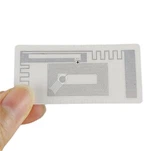
Passive RFID means that the tag itself does not have a power source, but is activated by radio waves emitted by the RFID reader to achieve communication and data transmission. Compared with Active RFID, it is smaller in size, lower in cost, and has a wider range of applications. As the most common type of RFID technology, Passive RFID has become a key component of the IoT identification layer with its low cost, simple structure, and long life. It is widely used in logistics management, retail inventory, asset tracking, access control and other scenarios. Compared with Active RFID, it is smaller in size, lower in cost, and has a wider range of applications.
Passive RFID systems usually include three parts:
1. Passive Tag: Contains antennas and chips, and common packaging forms include paper, plastic, ceramic, flexible, fabric, etc.
2. Reader: Transmits radio frequency signals, activates tags and receives returned data.
3. Data management system: processes and analyzes tag data, and connects to business systems such as WMS and ERP.
Advantages of Passive RFID
Low cost: Some tags can be priced as low as a few cents, suitable for mass deployment.
Long life: No battery maintenance is required, and it can work for many years in harsh environments, with a service life much longer than active tags.
Batch identification: The reader can read hundreds or thousands of tags at a time, greatly improving work efficiency.
Small size: Since there is no battery, the tag is smaller than the active tag and easier to install.

Typical applications of Passive RFID
Logistics and warehousing: Quickly identify pallets, boxes, and shelves to improve the accuracy and efficiency of inbound and outbound storage.
Retail and inventory: Quick inventory and anti-theft management of goods, clothing, shoes and bags to improve the level of store intelligence.
Industrial manufacturing: Component traceability, semi-finished product circulation, process control, and realize intelligent manufacturing.
Asset management: Fixed asset tag management to achieve positioning, usage records and life cycle monitoring.
Libraries and archives: Realize intelligent management functions such as book positioning, automatic borrowing and returning, and anti-loss.
As a professional RFID tag manufacturer, XMINNOV provides a variety of passive RFID tag solutions, including: anti-counterfeiting labels, LED tags, RFID seals, anti-metal tags, RFID sensors, etc.